The treatment against the tool
- Removes dead undercoat
- For double coats
- Never a shave-down
A salon de-shedding treatment is a deep bath, a high-velocity blow-out and an undercoat rake, from about $20 to $60 as an add-on to a bath. A de-shedding tool costs roughly $30 to $115 once. Neither stops shedding: both remove coat that has already died.
| The salon treatment | A tool at home | |
|---|---|---|
| What it removes | Dead undercoat across the whole coat, worked to the skin in one session | The dead undercoat you can reach, on the areas your dog will sit still for |
| What it costs | From about $20 small, $35 medium, $60 large, added to a bath | $30 to $115 once, plus ten minutes of your time, twice a week |
| How long | 1 to 2 hrs for a large double coat, most of it the blow-out | 10 to 20 min a session, repeated indefinitely |
| What the other cannot give | A high-velocity blow-out, which is what loosens the packed layer | Control over the week-to-week volume, at your own pace |
| Where it goes wrong | Raking a coat that should have been de-matted first | Blade tools on curly, wool or silky coats, which they damage |
.
Seven of the nine organic results for this search sell a de-shedding tool and only one describes the service. We are a matchmaker: we do not groom dogs, we sell no tools and we set no prices, so this page answers the questions that search page leaves open before it asks you for anything.
What a de-shedding treatment actually is
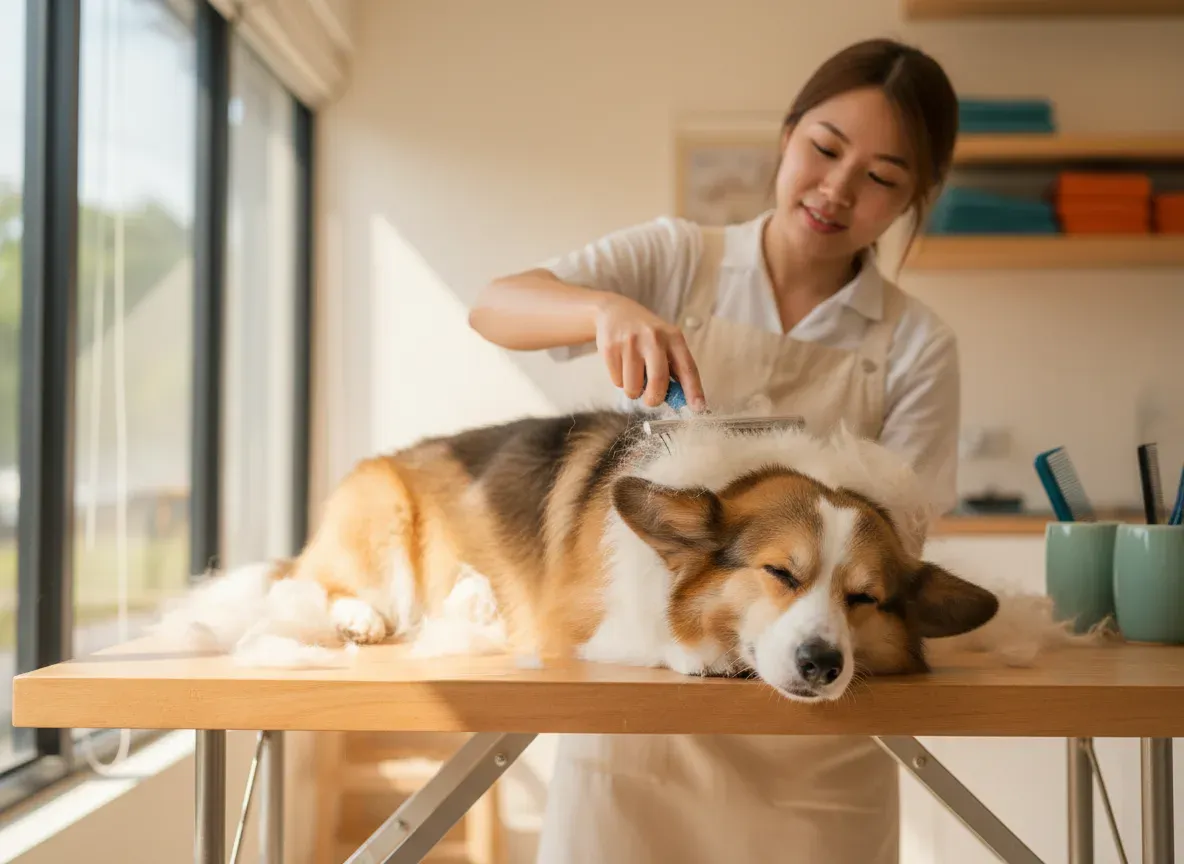
A dog deshedding treatment is a salon undercoat removal treatment: a deep bath, a high velocity blow out and an undercoat rake that lifts dead undercoat a brush cannot reach. It thins nothing and cuts nothing. The guard coat stays exactly as it was, which is why it is not a shave-down.
What the session involves
- A dry rake through the coat first, in sections, lifting what is already loose
- A deep de-shed bath, often with a de-shedding shampoo and conditioner
- A high-velocity blow-out with a force dryer, which does most of the work
- A second rake and carding pass once the coat is fully dry
- A skin check through the sections while the coat is open
What it is not
- Not a haircut. Nothing is clipped, thinned or shortened
- Not a shave-down. The guard coat is the layer protecting the dog
- Not de-matting. A mat has to come apart before a rake goes near it
- Not a cure for shedding. It changes when the fur leaves, not whether
- Not for curly, wool or silky coats, which have no undercoat to remove
The distinction that matters most is between de-shedding and shaving, because in this heat owners reach for the second when they mean the first. One removes the layer that traps heat. The other removes the layer that shields against it.
Does de-shedding hurt?
Done properly it should not hurt, because the coat being removed has already detached from the follicle. An undercoat rake lifts dead hair sitting loose in the coat, held there by the guard hairs around it rather than by the skin. A dog that is comfortable during a session usually leans into the rake, which is the honest tell.
Is deshedding painful for dogs is asked repeatedly in the People Also Ask box on this search page, and no Singapore publisher answers it. Here is where it does hurt: a rake dragged through a mat, because then the tool is pulling on hair still anchored to skin, and heavy pressure with a de-shedding blade, which scrapes rather than combs. Both are handling failures rather than features of the treatment, and SPCA Singapore on how dogs should be handled is worth reading before you choose who does it.
- Flinching, turning to the tool, or a dog that will not settle after ten minutes
- Skin reddening under the area worked, rather than pink from the blow-out
- A groomer working one spot repeatedly instead of moving through sections
- Any raking on a coat with mats in it, which needs de-matting first
Is de-shedding good for your dog?
Is deshedding good for your dog is the second question this search page throws up, and for a double coated dog the answer is yes, for a reason that has little to do with tidiness. Dead undercoat does not fall out cleanly. Loose undercoat trapped in the living coat settles against the skin and stops air moving through the layer whose whole job is moving air.
In a climate like this one, that dead coat trapped against skin is where trouble starts. Humidity and undercoat are a bad combination: a compacted layer holds moisture from a walk, a rain shower or a bath that never fully dried, and warm damp fur on skin is the standard recipe for hot spots under matted undercoat and for matting from trapped undercoat at the friction points. Airflow to the skin is the real benefit of the treatment.
Skin problems from trapped coat are the reason to book it, and the healthier coat after treatment is a side effect rather than the point. A shinier coat after a de-shed is simply what happens when the guard hairs are no longer being pushed apart from underneath. The schedule follows the coat, not the state of your floor.
Do dogs feel better afterwards?
Do dogs feel better after deshedding is the third People Also Ask slot here with no publisher attached. Most owners report a more active dog for a few days, and the mechanism is straightforward: less trapped coat means more airflow and less heat held against skin. Singapore heat and thick coats are a poor match, and a large double-coated dog carrying months of dead undercoat is wearing a jacket it cannot take off.
It is not a cure for heat intolerance on its own, and selling it as one would be dishonest. Cooling a dog properly is shade, water, airflow and walking at the cooler ends of the day, and heat management for a dog in Singapore does more than any grooming appointment can. The treatment removes one avoidable load. The rest is management.
How often, in a country with no winter
How often should a dog get a deshedding treatment is the fourth unanswered question on this search page, and every source that does answer it was written for somewhere else. Temperate guidance assumes a spring and autumn coat blow: a twice yearly shed, a few weeks of a dog blowing coat, and a schedule built around those two peaks.
Singapore has neither peak. There is no coat blow season here. Day length barely moves and the temperature range across a year is smaller than the range across a single day, so moulting runs at a low continuous shedding level instead of arriving as a seasonal moult. That is an observation about conditions rather than a veterinary finding, and it is why overseas shedding season advice reads oddly to owners in this market.
The working range here is every four to eight weeks: four to six for a heavy shedder, six to eight for a lighter double coat. The coat tells you where you sit inside it. Run your fingers backwards through the coat at the hindquarters. If undercoat lifts in a cloud and you can feel compacted undercoat under the guard hairs, that undercoat build up is your signal, whatever the calendar says.
Find a groomer who handles double coats
Request a de-shedding quote and get matched with a groomer who handles double coats every week. Say the breed in your enquiry, because it changes the match. Free, non-binding, and you book with the groomer rather than with us.
Which coats this is for
Coat structure decides this, not hair length. One product listing on this search page sells its tool for dogs with hair longer than two inches, which is the wrong variable entirely: Labrador shedding is enormous at well under two inches, and a poodle at six inches barely sheds at all. If you are still working out which service you need, all six services side by side sets them against each other.
Which breeds shed most is therefore a structure question rather than a size one. Corgi shedding and Pomeranian shedding are what we hear about most from flats; German Shepherd shedding and golden retriever shedding dominate on the private-property side. Shiba inu shedding, spitz coat care and Samoyed coat care all follow the same set of rules.
| Coat type | Examples | De-shedding? |
|---|---|---|
| Double coat guard coat over dense undercoat | Corgi, Pomeranian, Shiba, Husky, German Shepherd, Golden Retriever, Samoyed | Yes. This is the coat the treatment exists for |
| Short dense single coat | Labrador, Beagle, Pug, Frenchie | Yes, and routinely overlooked. Short does not mean low shedding |
| Curly and wool hair grows continuously | Poodle, Bichon, doodles and poodle crosses | No. A curly coat does not shed the same way: the hair stays in the coat and becomes matting |
| Long silky single coat | Shih Tzu, Maltese, Yorkshire Terrier | No. Silky coat shedding is light and constant. Brushing and combing, never a rake |
How a double coat works
A double coat structure is two layers doing two jobs. The topcoat is coarse guard hairs that shed water and block sun. Underneath sits the dense insulating layer of undercoat, and between them they give the dog thermal regulation in both directions.
Single coated breeds have the first layer and not the second, which is why a rake finds nothing on them. Coat density rather than coat length is what tells you which one you are holding.
Never shave a double coat to cool it down
The summer shave myth is the most expensive idea in tropical dog ownership. Shaving does not cool a dog with a double coat, because the undercoat insulates in both directions: it slows heat coming in exactly as it slows heat leaving. Taking it off exposes skin to direct sun instead of shielding it, so there is a real sunburn risk after shaving on skin that has never seen daylight.
Clipper damage to a double coat is the part that does not reliably come back. Guard hairs damaged at the base can produce patchy regrowth, a woolly texture where a coarse one used to be, or a coat that does not regrow at all: post clipping alopecia is the name for that outcome and northern breeds are the ones it happens to. Once that layer is gone the dog loses both its sun barrier and its ability to shed water. double coats in this climate, in full works through the argument at length, and welfare guidance on coat handling is the independent version of it.
De-shedding is the service that shaving gets reached for by mistake. It takes out the layer trapping heat and leaves the layer shielding against it, which is precisely what an overheating double-coated dog needs.
Fur everywhere: what actually changes
A treatment moves the fur from your home to the salon floor. That sounds glib and it is the most useful sentence on this page, because it sets the expectation correctly: what a de-shed removes is coat that was coming out anyway, so the only questions are where and when the fur leaves the dog. Shedding will continue afterwards, because new hair keeps completing its cycle.
What it does not remove is anything still living, which is why the volume drops rather than stopping. The week after a session is the noticeable difference, when coat queued to fall across the next month has already gone. By week three or four on a heavy shedder the volume is climbing back, and that is where the four to eight week range comes from.
A box promising to reduce shedding up to 90% is a manufacturer claim with no stated period, no coat type and nothing to measure against. Read it as marketing rather than measurement. Nothing removes hair that has not died yet, and any figure implying otherwise is describing one grooming session, not a change to the dog.
- Fur on the sofa and fur on the floor: less of both, noticeably, for a week or two
- Fur on clothes: the same, and black clothes and dog hair stay a permanent negotiation
- Vacuuming every day: still every day in shedding-heavy households, with less in the canister
- Allergies and dog hair: an allergy sufferer in the house reacts to dander, not to hair length
What it costs and how long it takes
Package versus add on is the first thing to clarify, and the answer is usually add on: a de-shed with a bath rather than a standalone de-shed, because the bath and the force dryer blow out are what release most of the coat. De-shedding price Singapore salons publish starts from about $20 for a small dog, $35 for a medium one and $60 for a large one, on top of the bath this is usually added to. Heavy coats are frequently billed as time instead, which is fairer to both sides.
How long does a de-shed take depends almost entirely on size and density: one to two hours for a large double-coated dog, and most of that is the high velocity dry rather than the raking. We set no prices and take no bookings, so treat these as market observation. current bands for every service is the single source of truth on this site and carries its own checked date, and your matched groomer quotes you directly.
- Small dog de-shed, moderate coat: often folded into the bath, 30 to 45 minutes
- Medium double coat: an hour or so, with the price moving on condition
- Large dog de-shed in full shed: one to two hours, commonly charged as time
- De-shedding for large breeds is where a package with a bath usually works out cheaper
- De-matting first if the comb catches, which is charged separately
Between treatments, at home
Ten minutes with a rake twice a week beats an hour once a month, and it is the difference between managing a coat and rescuing one. That is how long a home brush takes on a medium double coat once you are in the habit. Sectioning the coat is the whole technique: lift as you go, so the rake reaches the layer underneath instead of skimming the top.
Rake versus brush is worth getting right. A slicker brush finishes the surface and flatters the coat; an undercoat rake is the tool that actually reaches the dead layer, and the two are not interchangeable. Never attempt a wet de-shed at home either, because damp undercoat compacts under a tool rather than lifting out of it.
Where owners stop too early is consistent: the trousers at the back of the hind legs, the ruff around the neck, and the skirt behind the front legs. Those three hold the densest undercoat on most double-coated dogs and get the fewest strokes. For the technique itself, keeping a coat combable at home covers the comb, the direction and the order to work in.
The pile on the floor
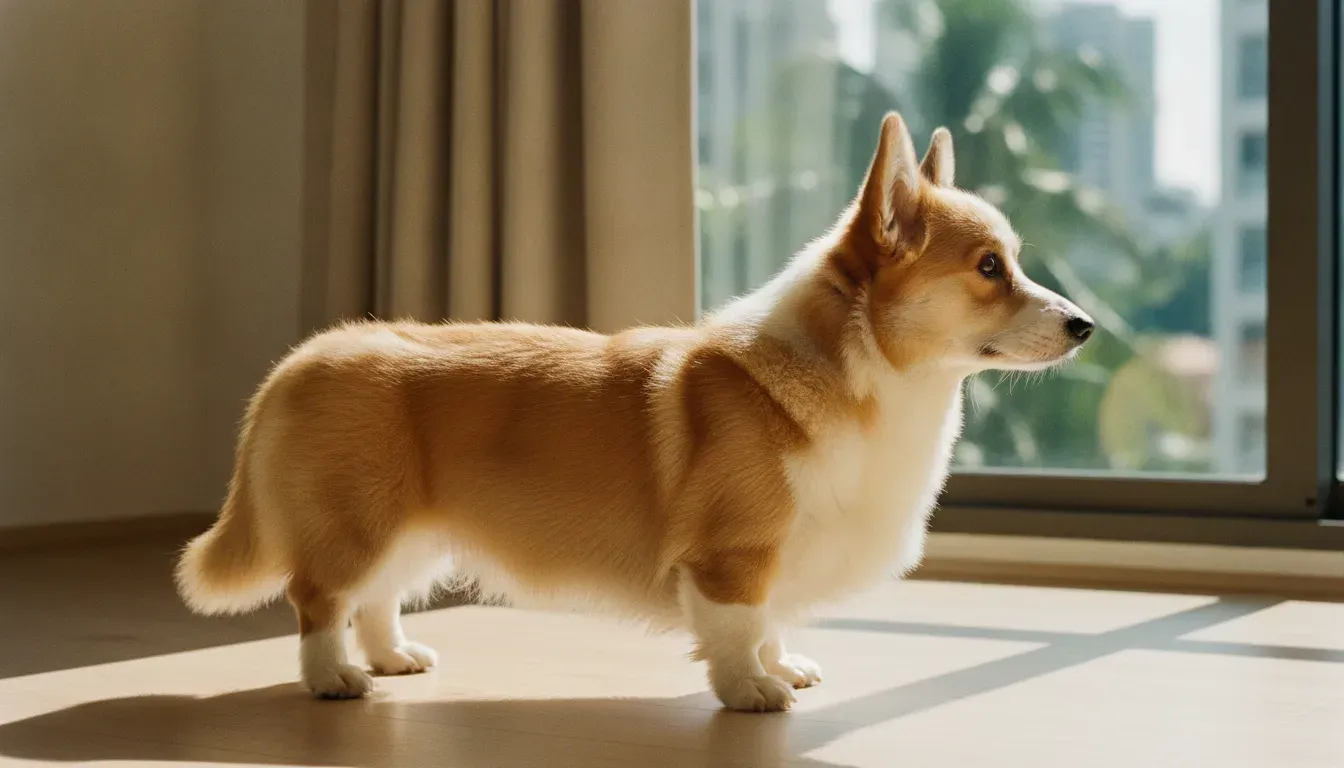
The volume of dead undercoat that comes out of a double coat is the argument for this treatment, and it is the part owners never see. A large double-coated dog in full shed typically takes one to two hours, most of it the blow-out rather than the raking.
De-shedding, de-matting or a full groom?
Which service does my dog need is the question underneath most enquiries, and three services get confused constantly. De-matting versus de-shedding and full groom versus de-shed are the two pairs that trip people up. The test is what the coat is doing rather than how it looks from across the room.
| What is happening | What to book |
|---|---|
| Fur coming off on your hands, your clothes and the floor | De-shedding |
| Comb catches and will not pass through to the skin | De-matting first, then de-shedding |
| Coat growing over the eyes, or dragging | Full groom, if it is a coat that gets cut |
| Double coat with mats in it | De-mat, then de-shed. Not a clip-off by default |
When de-shedding is the wrong service
Four cases make this the wrong purchase, and a groomer who tells you so is worth keeping. Curly and wool coats come first: there is no dead undercoat to collect, so a rake finds only living hair and breaks it. Those coats need brushing to the skin and a haircut on schedule.
Heavily matted coats are second, because a mat has to come apart before anything can be raked through it. Sudden hair loss with bald patches and visible skin under the coat is third, and it is when shedding is a vet problem rather than a grooming one: hormonal conditions, parasites, shedding from stress and shedding after illness all produce coat loss no treatment fixes. Puppies still in a soft first coat are fourth, and they have no undercoat to remove yet.
What to ask a de-shedding groomer
Five questions tell you whether the person in front of you works on double coats routinely or occasionally. All five are reasonable, and none are difficult if the answer is yes.
- What tools will you use on this coat, and in what order?
- How will you check the skin as you work through the sections?
- Will you stop if my dog stops being comfortable?
- How long will the blow-out take for a dog this size?
- Do you have a force dryer, and where does the drying happen?
Why we do not sell a tool
Type dog deshedding singapore into Google and seven of the nine organic results sell you a tool. That is the honest context for this page: we have no product to move, so nothing here is shaped by the margin on a rake.
Deshedding tool Singapore listings run from a bamboo deshedding tool at the cheap end to a FURminator or an equivalent branded blade at the top, roughly $30 to about $115, observed on live Singapore retail listings on 25 July 2026. If a tool suits your dog, buy the tool. DIY deshedding at home is the right answer for plenty of short dense coats and for anyone willing to spend ten minutes twice a week. who receives your enquiry sets out what happens if you do decide to use us instead.
Tool versus treatment is the comparison this search page never makes, and the reason is that the pages making it up are selling one side of it. What a tool cannot reproduce is the bath and the force dryer, which is the part that actually loosens the packed layer. Most owners of heavy shedders end up doing both.
Coat, climate and the rules that apply here
Singapore's double-coated population skews small because of where most dogs live. Corgis, Pomeranians and Spitz types are common in flats, while the large double coats, the huskies, shepherds and retrievers, are mostly a private-property population. AVS limits of ownership sets out the ownership rules shaping that distribution, and it is worth reading if you are choosing a breed rather than grooming one you already have.
There is no grooming licence to check either. The AVS list of licensable animal-related businesses covers pet breeding, boarding and animal farms, and grooming-only premises do not appear on it, while public guidance does not confirm whether they need one. That is an observation about the published list rather than a legal conclusion. NParks AVS pet licensing covers your own dog's licence, a separate obligation that does apply to you.
The HDB flat shedding problem is a space problem more than a volume one, because the same coat in 90 square metres is simply more visible. Air conditioning and shedding come up constantly here too: a cooler flat makes a dog more comfortable and does not switch shedding off, because the trigger for a dog in the tropics was never the indoor temperature.
For a long blow-out the thing to check is the room rather than the paperwork. Ask where the drying happens, whether the dog is supervised throughout, and how heat is managed for a flat-faced dog or a very heavy coat. Those answers tell you more than any badge on a wall.
What we do with your details
Your details go to matched Singapore groomers so they can quote you, and to nobody else. We do not sell your data on and we do not add you to a marketing list. The Personal Data Protection Commission sets the rules we work to, and the full statement sits on our how-it-works page.
Read this before you book
Two guides go deeper than a service page can. The double-coat guide is the one to read if you own a Corgi, a Husky, a Shiba or a Pomeranian, because it works through what this climate does to that coat structure across a year. After that, grooming intervals for this climate sets the interval by coat type, and that is the number deciding your annual cost.
- Double-coated dogs in Singapore's heat, in our guides section
- Preventing matting between grooms, which is the two-minute habit
- How often to groom here, coat type by coat type
De-shedding groomers across Singapore
We cover island wide de-shedding, studio and mobile, and hold no premises of our own. There is no branch list because there are no branches: what exists is a pool of independent groomers across Singapore who quote you directly, and an enquiry goes to the ones covering your postal code who take your dog's coat.
Searching de-shedding near me returns the local pack and a row of product listings, which is why it is worth saying the breed out loud when you enquire. Ask for someone experienced with spitz breeds if that is what you have, and ask for a groomer with a force dryer either way.
Mobile de-shedding Singapore wide is possible, and a big blow-out is the one thing worth checking before booking a van. a groomer with a van at your block covers where mobile setups do and do not have the power and water for a large double coat in full shed, which is the service where the gap between a studio and a van is most likely to show.