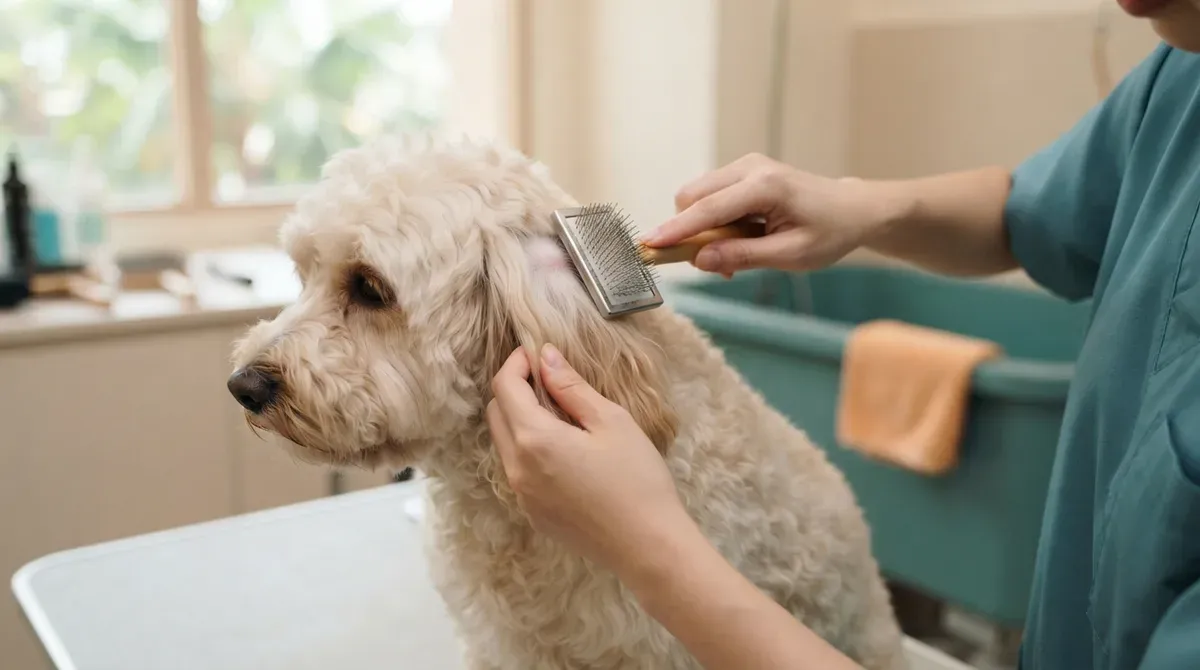
What a mat actually is
A mat is not just a tangle that got worse. It is loose, shed hair that never fell out of the coat, wound around the hairs still growing, and then compressed by movement and moisture until it forms a dense felt. Once that felt has formed, brushing the top of it does nothing — the knot is anchored at the skin, and the brush is skating across a surface that is no longer connected to anything you can free.
That matters because it changes what you are trying to prevent. You are not trying to keep the coat looking tidy. You are trying to keep shed hair moving out of the coat before it has a chance to lock in. A dog can look perfectly presentable on the outside and be solidly matted underneath — which is exactly the dog that arrives at a groomer and leaves with a much shorter cut than the owner expected.
Why Singapore's climate makes it worse
Three things about living here work against a coat. Humidity keeps the coat slightly damp for far longer after a bath or a walk, and damp hair tangles and then tightens as it dries. Heat means more frequent bathing, and every bath that goes onto an un-brushed coat sets whatever tangles were already there. And year-round warmth means many dogs here shed steadily all year rather than in two clean seasonal blowouts, so there is always loose hair sitting in the coat.
The practical consequence is that a brushing routine that works fine in a temperate climate is often not enough here. If you have read that twice a week is plenty for a doodle, assume the Singapore version of that advice is closer to daily — especially if your dog walks in the late afternoon heat and comes home damp, or swims, or spends time in air-conditioning and then out in humidity.
Where mats form first
Mats do not appear evenly. They start wherever the coat is rubbed, compressed or kept damp, which means you can catch almost all of them by checking seven places. Check these first every time — if these are clear, the rest of the coat usually is too.
The harness problem nobody mentions
A harness is better for your dog's neck than a collar, but it is a mat factory on a long or curly coat. It presses the coat flat against the skin along fixed lines and holds it there for the length of every walk. If your dog wears a harness daily, brush the harness lines specifically after every walk — thirty seconds each side is usually enough — and take the harness off at home rather than leaving it on.
Cooling vests, raincoats and clothing
Anything worn over the coat does the same thing as a harness, only across a much larger area. Cooling vests in particular are worn damp by design, which is the worst combination: pressure plus moisture. If your dog wears one, brush underneath it before and after, and dry the coat properly rather than letting it air-dry flat.
- Behind and under the ears, where the coat is fine and constantly rubbed
- The armpits, where the front legs meet the chest
- The collar line, especially under a collar worn all day
- Harness contact points across the chest and behind the shoulders
- The back of the hind legs and the britches
- Around the tail base and under the tail
- Between the toes and around the paw pads
Line brushing: the technique that works
Most owners brush the way you would brush your own hair — long strokes over the top of the coat. On a single short coat that is fine. On anything longer or curlier, it produces a coat that looks brushed and is matting quietly underneath. Line brushing fixes that, and it is the single most useful skill an owner of a coated dog can learn.
How to do it
- Sit your dog comfortably — on your lap, on a bed, wherever they settle
- Start at the bottom of a leg or the lowest part of the body
- Use your free hand to push the coat upward, exposing a horizontal parting down to the skin
- Brush only the small band of coat below that parting, outward from the skin
- Release a centimetre more coat, brush again, and work steadily up the body
- Finish every section with a metal comb before you move on
Why the comb, not the brush, is the test
A slicker brush has flexible pins that bend around a mat and glide over it — which is why a coat can feel brushed and still be matted. A metal comb has rigid teeth that stop dead at anything solid. Run the comb from the skin outward. If it passes cleanly all the way through, that section is finished. If it snags, you have found something the brush missed, and that is the spot to work on now rather than at the groomer's in three weeks.
The tools that actually matter
You do not need a large kit. Two tools do most of the work, a third helps on specific coats, and a couple of popular products are worth being careful with.
| Tool | What it is for | Notes |
|---|---|---|
| Slicker brush | Lifting loose hair out of medium, long and curly coats | Hold it lightly — pressure scratches the skin. A soft-pin slicker suits fine coats and puppies. |
| Metal comb | Testing your work, and detailing ears, face and legs | The non-negotiable one. A comb with wide teeth at one end and fine at the other covers most dogs. |
| Undercoat rake | Pulling dead undercoat out of double coats | For Spitz types, Corgis, Huskies, Shibas. Not for single-coated or curly dogs. |
| Detangling spray | Reducing friction on dry coat before brushing | Useful. Never brush a completely dry curly coat — a light mist makes it easier and less breakage-prone. |
| Dematting rake or splitter | Cutting through an existing mat | Sharp blades. Easy to catch skin. Better left to a groomer unless you have been shown how. |
How often to brush, by coat type
Frequency matters more than session length. Five minutes daily beats forty minutes on Sunday, because a mat that has not had time to compress comes out in seconds. Use this as a Singapore-adjusted baseline and adjust upward if your dog swims, wears a harness daily, or is blowing coat.
| Coat type | Typical breeds | Brush | Watch for |
|---|---|---|---|
| Curly / wool | Poodle, Cavapoo, Maltipoo, doodle crosses | Daily | The whole coat mats, not just friction points |
| Long silky | Shih Tzu, Maltese, Yorkshire Terrier | Daily or every other day | Behind ears, armpits, under the collar |
| Double coat | Corgi, Shiba, Pomeranian, Husky | 2–3× a week, daily when shedding | Dense packed undercoat on the hips and ruff |
| Wire | Schnauzer, most terriers | 2× a week | Furnishings on the legs and beard |
| Short single | Beagle, Pug, French Bulldog, Dachshund (smooth) | Weekly is plenty | Skin folds rather than mats |
Bath day rules
More coats are ruined on bath day than on any other day. Water is what turns a loose tangle into a locked mat: wet hair swells, twists around itself, and then shrinks tight as it dries. Every rule below follows from that one fact.
- Brush and comb before the bath, never after only
- If a section will not comb through, deal with it before water touches it
- Rinse until the water runs completely clear — residue makes coat sticky
- Dry actively with a dryer and a brush, not by towelling and hoping
- Never let a curly or long coat air-dry flat against the skin
- Comb through once more when the coat is fully dry
Telling a tangle from a mat
The distinction decides what you do next. A tangle is loose, moves when you push it, and separates with fingers and a comb. A mat is compressed, does not move independently of the skin, and often has a flat, felted underside. A pelt is when mats have joined into a continuous sheet — at that point the coat lifts away from the body as one piece.
The quick check: try to slide your fingers between the knot and the skin. If you can get a finger underneath and the knot moves freely, you are usually dealing with a tangle and can work it out. If it sits tight against the skin and pulls when you lift it, stop — that is a mat, and working at it will hurt.
When a mat has already formed
Three things not to do, in order of how much damage they cause. Do not bathe the dog — water tightens mats and makes them significantly harder to remove. Do not pull, tug or work at a tight mat with a brush; the pain is under the mat, on the skin, and your dog will remember it and resist brushing for months afterwards. And do not cut a mat out with straight scissors: matted skin lifts up into the mat, so the skin is often much closer to the blade than it looks, and scissor injuries during home dematting are common enough that most groomers can describe several.
What to do instead depends on the size. A single small mat, loose enough to get a finger under, can often be split gently with your fingers, worked from the outer edge inward with the tips of a comb, and never from the skin outward. Anything larger, tighter, or in a sensitive spot — ears, armpits, groin — is a job to book rather than attempt.
Why a groomer may recommend clipping it off
Owners often hear "we'll need to take it short" as a failure. It usually is not. Dematting a heavily matted coat means hours of controlled pulling on skin that is already sore, and the humane threshold most groomers work to is roughly: if brushing it out would cause more distress than a short cut, the coat comes off. The coat regrows. A dog that has learned grooming is painful takes far longer to fix.
If you want to avoid ever being in that conversation, the lever is entirely in the weeks between appointments — which is what everything above is about. Our de-matting page explains how groomers price and approach that work.
When it is skin, not brushing
Occasionally a coat mats no matter how conscientious the owner is, and the reason is underneath it. Recurrent mats in the same place, a smell, greasy or flaky coat, redness, or a dog that suddenly objects to being brushed in a spot they never minded before are all worth a vet's opinion rather than a harder brush. Skin conditions change how coat behaves, and yeast and allergy flare-ups are common in this climate.
The same goes for a sudden change in shedding. A dog that starts dropping coat heavily out of nowhere, or whose coat texture changes, may have something going on that grooming cannot fix — and no brushing schedule will out-run it.
Building a routine the dog tolerates
The routine that survives is the short one. Two or three minutes after the evening walk, on the sofa, with the dog relaxed, is worth more than a weekly session that both of you dread. Keep the sessions well inside your dog's patience, stop while it is still going well rather than when they have had enough, and pair it with something they like.
For puppies this doubles as training. A dog handled gently on the paws, ears and tail from the start is a dog that stands calmly on a grooming table later, and that is worth as much as the coat care itself — see our guide to a puppy's first groom for how to build that early.
- Same time, same place, every day — habit beats willpower
- Handle paws, ears and tail even on days you do not brush
- Stop before your dog asks you to
- Reward at the end of the session, not to interrupt a struggle
- Book the professional groom before the coat needs rescuing