What is in a bath and tidy, and what is not
- No haircut
- About an hour
- Nails and ears included
A dog bath and groom in Singapore runs about $45 to $75 for a small dog, $65 to $95 for a medium one and $90 to $160 for a large or heavily coated dog. Price by dog size is the main lever. Budget about an hour on the table for a small dog, and expect no haircut at that price.
| Dog size | Price band | Typical time | Not included at this price |
|---|---|---|---|
| Small to 10kg | $45–75 | about 1 hr | No haircut. A silky coat grown over the eyes needs a full groom instead |
| Medium 10 to 25kg | $65–95 | 1–1.5 hrs | No haircut, no de-shed. A coat dropping fur needs de-shedding added |
| Large 25kg and up | $90–160 | 1.5–2 hrs + | No haircut, no de-shed. A heavy double coat often needs the de-shed to dry at all |
.
We are a matchmaker: we do not groom dogs and we set no prices, so the bands above are synthesised from rate cards published by independent groomers Singapore owners already use, studio and mobile, checked on 25 July 2026. The groomer sets the price. What a band cannot tell you is what each salon puts inside the package, and that is where this service gets confusing.
“Basic” is not a standard in Singapore
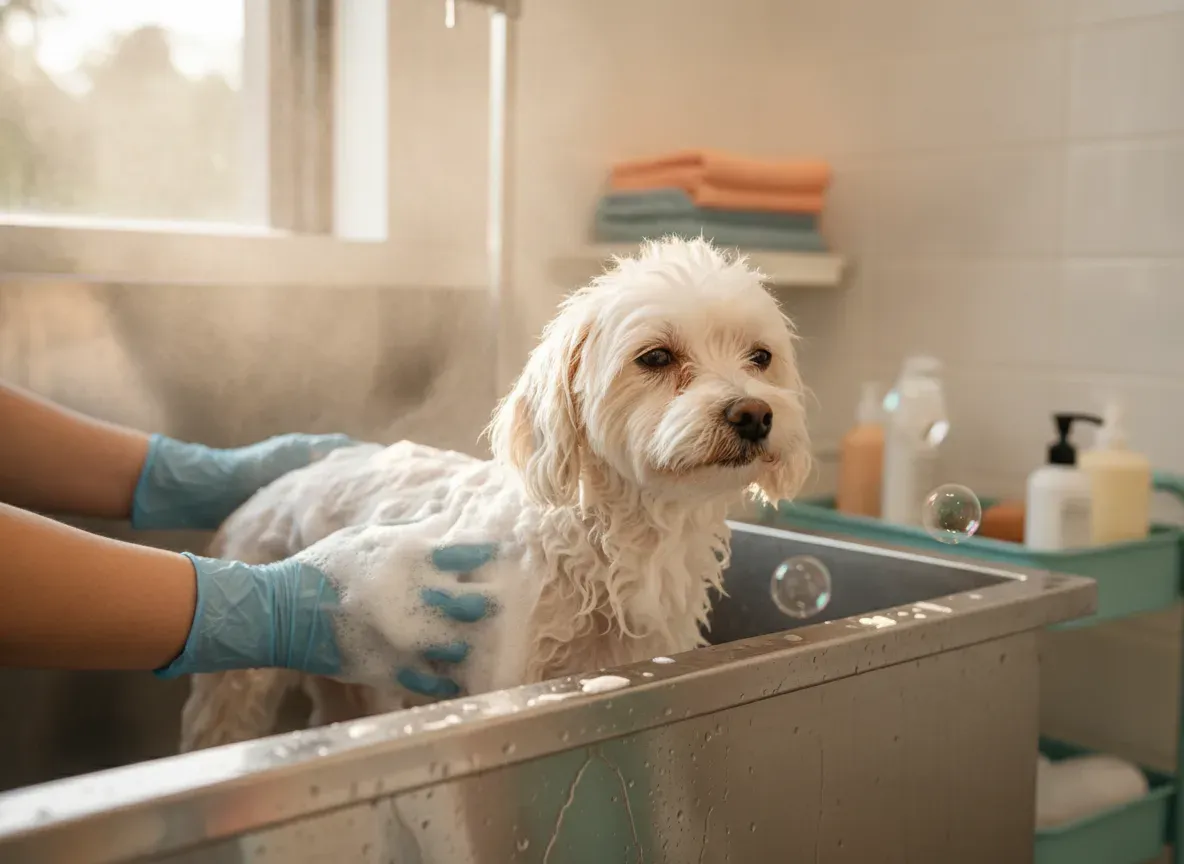
A bath and tidy, sold in Singapore as basic dog grooming, is a bath, blow-dry, brush-out, nail trim, ear clean and a light face, paw and sanitary tidy, with no haircut. It usually takes about an hour and is cheaper than a full groom.
In almost every version of it
- Bath with a shampoo for dogs matched to the coat, a double shampoo where needed, then rinse thoroughly
- Bath and blow dry to the skin, which is the longest stage of the appointment
- Comb through first, then a brush out after drying to finish
- Nail trim included, usually nail clipping and filing
- Ear cleaning included, with an ear cleaning solution rather than water
- Face tidy, feet trim, paw pad trim and a sanitary clip around the hygiene areas
Not included in a basic groom, or charged on top
- Any haircut. No haircut included is the line that separates the two services
- A de-shedding add on for a double coat, quoted separately
- A de-matting surcharge, charged as time when the comb cannot pass
- A medicated shampoo add on, a flea and tick bath, a teeth brushing add on
- Ear plucking and anal gland expression, offered by some salons and declined by others
The same service is sold as an express groom, a wash and go, a tidy up groom, a bath and fluff or bath and fluff time depending on the salon. Four Singapore salons on one search page defined basic grooming Singapore owners buy in four different ways: nails, ears and a tidy in one, bath, ear, nail and paw pad in another, bath and fluff with nail filing in a third, and a six-item list in the fourth. None of them mentions that the others disagree. Ask for the basic groom inclusions rather than the package name, and if you are still choosing between services, all six services compared sets them side by side.
Brush before the bath, never after
Brushing goes before the bath, never after it. A comb passes to the skin while a tangle is still dry and loose, and the same tangle turns into a mat the moment it is wetted and then dried. Ten minutes of line brushing before washing can save an hour of separating mats later, on the same dog, in the same week.
Water tightens tangles and drying sets them. A tangle is fur wound loosely around itself, so washing swells each strand, pulls the wind tighter, and a wet coat sets mats hard as the air hits it. That is why you detangle before water rather than after, and it is the same fact that governs de-matting: you never bathe a matted dog.
The brush out after drying is a different job. That one is finishing work, lifting the coat and checking the tidy is even, not detangling, because the detangling already happened. Comb through first is the whole rule, and if you want the technique rather than the timing, brushing that keeps a coat combable covers the comb, the direction and the order to work in.
Why the drying takes longer than the bath
Drying is the longest stage of a bath and blow dry, and the wash is one of the shortest. Owners picture the appointment as a bath with some tidying attached, so an hour sounds generous for a small dog. On the table the wash is fifteen to twenty minutes of it, and everything after that is getting the coat dry to the skin.
Drying to the skin matters more than anything else in this service. A high velocity dry pushes water out of the undercoat instead of evaporating it off the top, which is why drying takes the time it does and why it cannot be rushed on a thick coat. Towel dry then blow dry is the order, and a half dried coat is the source of most damp undercoat problems.
The whole appointment is still quicker than a full groom, an hour against two to four, so a bath and tidy is usually a same visit collection rather than a drop off and collect job. Large dog drying time is where that changes: sixty to ninety minutes of drying alone on a heavy coat, before anything else is done.
| Stage | Typical time | What moves it |
|---|---|---|
| Comb through and brush out | 5 to 15 min | How long since the last groom, and coat length |
| Bath and rinse | 15 to 20 min | Coat density, and whether a double shampoo is needed |
| Drying to the skin | 20 to 40 min | Undercoat density. The longest stage on almost every dog |
| Nails, ears, face, paws, sanitary | 10 to 15 min | Temperament, more than size |
Do groomers actually bathe the dog?
Yes, and the bath is the part of the service a home setup cannot match. A grooming bath has warm running water at a usable pressure, a hose that reaches the skin through a dense coat, and room to rinse thoroughly rather than approximately. Water temperature for a dog sits well below what feels hot to a hand, which is one of the first things a home bath gets wrong.
A rinse that leaves shampoo behind is one of the commoner causes of a dog scratching two days later, because residue causes itching long after the coat looks clean. Dog shampoo pH is not ours, so human shampoo damages skin over repeated washes, and human shampoo not for dogs is the single rule worth carrying home from this page.
What the tidy actually covers
The tidy is the part with no agreed name, so here is what it means in practice.
- A paw pad trim, because paw pad fur slipping on tiles is a real hazard for an older dog
- Trimming between the pads and the long fur between toes
- A face wash for tear stains, plus eye area hygiene at the corners
- Sanitary area hygiene, the clip that keeps the back end clean between grooms
- Ears cleaned with an ear cleaning solution. The ear plucking debate is live, and when not to pluck ears is a vet question
- Anal gland expression is its own debate, and the current view is only when needed
- Oatmeal shampoo and hypoallergenic shampoo for reactive or itchy skin
- Anti fungal shampoo and flea shampoo, which usually need contact time on the coat
- Puppy shampoo for a first groom, and whitening shampoo for pale coats
- A conditioner after shampoo on long silky coats, to help the comb move
Book a bath and tidy
Request a bath and tidy quote and get matched with a groomer who does this every day. Say the coat type when you enquire, because it changes both the time and the price. Free, non-binding, and you book with the groomer rather than with us.
Which dogs never need more than this
Some coats have no haircut to give, and their owners are buying full grooms they do not need. Does my dog need a full groom is a coat question rather than a budget one, and a short coat only needs a bath: smooth coat maintenance is a wash, a proper dry and a nail trim, and that is the whole job. Nobody selling grooming has an incentive to say so, which is roughly why nobody does.
A double coat is the second case and a stronger one. Clipping a double coat removes the guard hairs that shield the skin and does not cool the dog, so what that coat needs is the bath with adding a de-shed to the bath, not a clip. Most grooming here is small-breed work for a structural reason: the breeds kept in HDB flats skew small, and a good share of them are short-coated.
- Short smooth coats: Beagle, Labrador, Pug, Dachshund. The bath is the whole appointment
- Double coats: a corgi bath and de-shed, a Shiba, a Pomeranian bath and fluff
- Dogs already kept in a short clip, between two or three haircuts a year
- Senior dogs who cope with an hour on the table but not with three
The alternating pattern, and what it actually saves
Alternating grooms means a full groom then bath and tidy, then a full groom again. The haircut sets the shape and the maintenance groom between full grooms keeps the coat clean and combable without paying for a cut the shape does not need yet. It works on curly and long silky coats, the two types that grow continuously and are otherwise on the haircut treadmill.
You will see the claim that this will halve your annual grooming cost. It will not, and the arithmetic is worth doing rather than repeating. Swapping every second visit saves roughly $40 each time on a small dog, about $160 across a year of six-weekly appointments, which is a useful sum and nowhere near half. Figures below use the midpoints of the bands published on what each service costs.
A grooming schedule Singapore coats actually hold to is a wash every four to six weeks and a haircut every six to eight. AVS puts continuously-growing coats at professional grooming every six to eight weeks, so the bath in between is what covers the gap the haircut interval leaves.
| Pattern | Visits a year | Rough annual cost |
|---|---|---|
| Full groom every visit | 9 full grooms | about $900 |
| Alternating full groom and bath and tidy | 5 full, 4 bath and tidy | about $740 |
| Bath and tidy only short and smooth coats | 9 bath and tidies | about $540 |
How often is too often?
How often can you bathe a dog here is roughly monthly, which is more often than the same dog would need in a temperate country. A Singapore humidity coat rarely dries fully between walks, and a damp coat after a walk is what turns a four-week interval into a three-week one. Skin issues in a humid climate follow the same pattern.
Over bathing a dog is the other failure. Washing weekly strips the coat's oils faster than the skin replaces them, so over washing skin damages the skin barrier and produces exactly the dry skin from frequent baths that the washing was meant to prevent. Smell between grooms and a greasy feel at the shoulders are the signal to book, not the date on the calendar. For interval by coat type, how often a groom is due here sets it out coat by coat.
Skin conditions change the answer completely. A dog on medicated shampoo may be on a schedule a vet set, sometimes twice weekly for a fixed period, and that instruction outranks anything a groomer or this page says.
- Paw wipes and a quick wipe down after a walk, which handles most of it
- Spot clean between baths where the dirt actually is, usually feet and belly
- Dry shampoo for dogs or a waterless foam on a coat that cannot be washed yet
- A freshening spray masks smell rather than removing it, so use it sparingly
Bathing at home in a Singapore flat
Why home baths go wrong is nearly always a drying problem rather than a washing one. No bathtub at home is the starting condition in most flats, so bathing a dog in a HDB bathroom means a wet tiled floor, a handheld shower head and someone crouching, which makes the chest and belly hard to reach and a squirming dog harder to hold. The wash usually ends before the rinse is genuinely finished.
Drying is where it fails properly. A towel and a domestic hair dryer move air across the top of the coat and leave the undercoat wet, so a dog that feels dry to the hand is often still damp against the skin. In this humidity a half-dried coat stays half-dried, and a damp undercoat smells within about three days. That yeasty, damp dog smell is the honest answer to why a bath at home does not seem to last.
Wet dog, dry dog
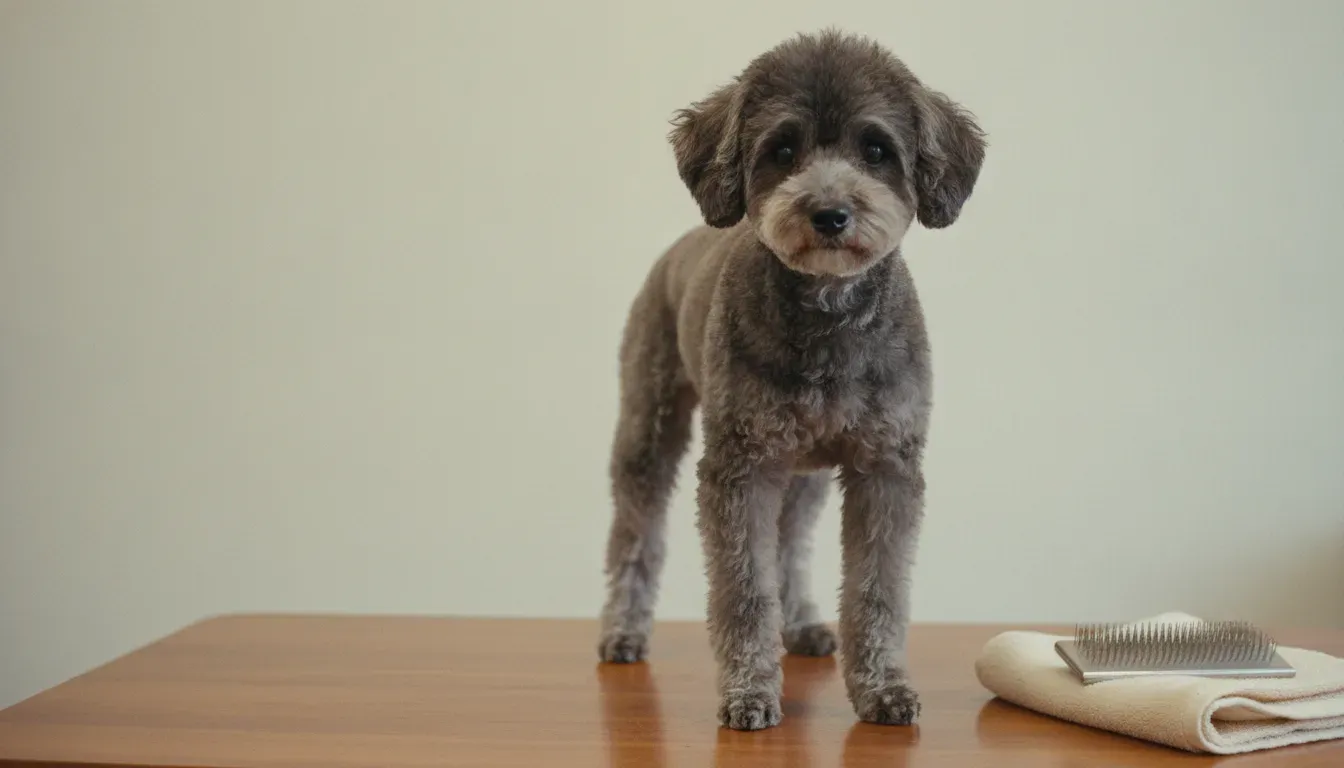
The stage owners never see, and the one that decides whether the bath holds. On a small dog this took a little over half an hour, against fifteen minutes for the wash itself.
Bath and tidy or full groom?
The coat decides this, not the budget. One test settles it in about five seconds at home: look at whether the shape from the last haircut is still doing its job, and whether a comb runs from the skin to the tip without catching.
| What you are looking at | What to book |
|---|---|
| Coat still in shape, dog can see out, comb runs clean | Bath and tidy |
| Coat over the eyes, dragging on the floor, catching on things | Full groom |
| Comb catches and will not pass to the skin | De-matting first, then the groom |
| Fur on every surface in the flat | Bath and tidy with a de-shed added |
When a bath and tidy will not be enough
A matted coat cannot be bathed as booked, so the appointment changes before it starts. Mats sit tight against the skin and water sets them harder, which leaves the groomer separating them by hand or clipping the coat off underneath them. Either way it is de-matting first, if the comb catches, and the de-matting surcharge is charged as time on top of the bath.
A heavy double coat in full shed can be the same story for a different reason. Enough dead undercoat trapped against the skin will not dry properly however long the dryer runs, so a de-shedding add on there is not an upsell, it is what makes the drying work at all.
The call is the thing to agree in advance. A groomer who rings before adding time is telling you exactly what kind of business you have walked into, and the question to ask at the counter is what the ceiling is: what is the most this can cost today, and at what point do you stop and phone me.
What to ask when you book
Four questions make the package-name problem disappear. None of them are confrontational and a groomer worth booking answers all four without pausing, which is roughly the test SPCA Singapore's guidance on choosing a groomer sets out as well.
- What exactly is in your basic package, item by item?
- What will you tidy: the face, the paws, the sanitary area?
- How will my dog be dried, and is the dryer supervised?
- Will you call before extra charges?
- How long will my dog be with you, drop off to collect?
Drying, welfare and what to check
Drying is where the risk in this service sits. It is the longest stage, the one the owner never sees, and the one involving heat and a machine. A force dryer, a stand dryer, a cage dryer and hand drying are four different things: the first three move air at the dog and only fluff drying by hand puts a person on the coat throughout. Supervised drying is the phrase to use when you ask, and it is worth observing how dogs are handled while they wait.
Flat faced breed drying care needs naming specifically. A Pug, a Frenchie or a Shih Tzu cannot shed heat by panting as efficiently as a longer-muzzled dog, so warm air, a warm room and stress together carry a real risk of heat stress during drying. Breaks during drying are normal, and a groomer who builds them in is not being slow.
There is also no grooming licence for you to check. The AVS list of licensable animal-related businesses covers pet breeding, boarding and animal farms, and grooming-only premises do not appear on it, while public guidance does not confirm whether they need one either. That is an observation about the published list rather than a legal conclusion. NParks AVS pet licensing governs your own dog's licence, which is a separate obligation and one that does apply to you.
What we do with your details
Your details go to matched Singapore groomers so they can quote you, and to nobody else. We do not sell your data on and we do not add you to a marketing list. The Personal Data Protection Commission sets the rules we work to, and how we decide who to send you to carries the full statement.
Read this next
Three guides on this site answer the questions that come after this one, and none of them ask you for anything. The signs guide is the one to read if you are not sure the dog is due at all, because the useful signals are the ones you can feel with a comb rather than see across the room.
- Signs your dog needs grooming, in our guides section
- How often to groom a dog in Singapore's climate, by coat type
- Preventing matting between grooms, which is the two-minute habit
Groomers across Singapore
We match island wide groomers, studio and mobile, and we hold no premises of our own. There is no branch list to give you because there are no branches: what exists is a pool of independent groomers across Singapore, and an enquiry goes to the ones covering your postal code who take your dog's coat type.
A mobile bath and tidy suits this service particularly well. It is the shortest appointment of the six, so a mobile bath appointment parks downstairs for about an hour rather than half a day, and the dog never sits in a waiting area. a groomer who comes to your block covers what a van can and cannot do, including where its dryer runs out of power against a large coat.
Looking for the cheapest bath and groom and looking for the best one end at the same rate cards. What separates two quotes at the same price is drying time and what the tidy includes, which is why this page spends more words on those two than on the figures.