What de-matting actually costs in Singapore
- Charged as time, not penalty
- Real 2026 SG rates
- Welfare decides the method
Dog dematting in Singapore is charged four incompatible ways. The same twenty-minute job costs $40 at $10 per five minutes, $30 at $30 per half hour, at least $15 on a from-price, and $60 for a two-groomer session. The unit, not the salon, is what moves the total.
| How it is charged | A 20-minute job | A 30-minute job | An hour | Per hour equivalent |
|---|---|---|---|---|
| $10 per 5 minutes | $40 | $60 | $120 | $120 |
| $30 per half hour | $30 | $30 | $60 | $60 |
| From $15, no ceiling published | $15 or more | $15 or more | $15 or more | Not published |
| $60 for 20 minutes, two groomers dematting | $60 | Not published | Not published | $180 of clock time, $90 per groomer |
.
De-matting is the removal of felted, tangled coat by hand, with a rake and a mat splitter, and it is charged by time because it takes time. Dematting Singapore rates run from $10 per five minutes to about $30 per half hour, which is why the same twenty minute job can cost $15 or $60 depending purely on who is holding the comb.
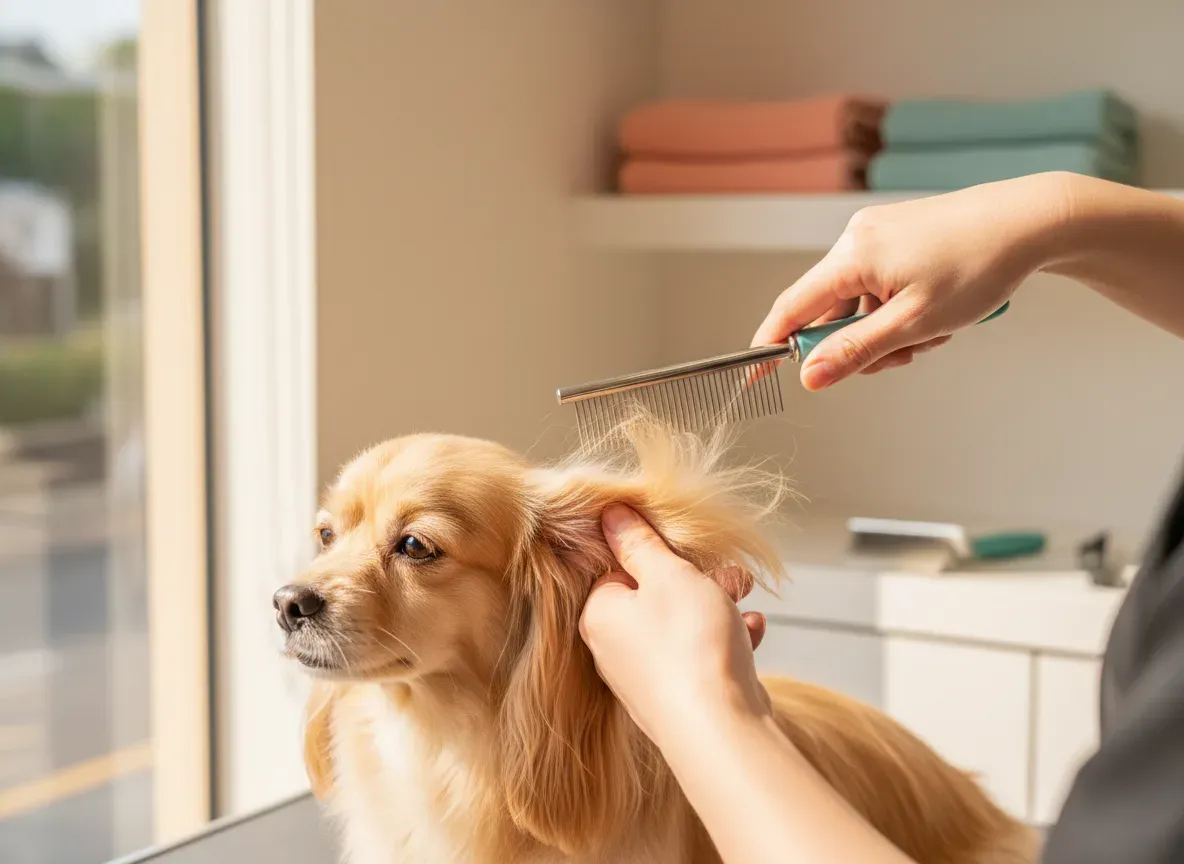
What de-matting is, and what a groomer is deciding
De-matting is the removal of tangled, felted coat by hand and with a rake or splitter, charged by time because it takes time, commonly $10 per five minutes or about $30 per half hour in Singapore. Where mats are tight to the skin, a short clip is the humane alternative rather than a failure.
What the session involves
- A coat assessment at the skin, not from the top
- Each mat worked from the ends inward with a dematting rake, a mat splitter tool and fingers
- A dematting comb through every section afterwards to check the work
- Small sections, breaks, and a stop if the dog has had enough
- A bath after dematting, once the coat runs clear
What the groomer is weighing up
- Whether a comb can pass under the mat without lifting skin
- How long the whole coat would take, and whether that is fair on this dog
- The dog's age, tolerance for handling and skin condition
- Whether a spot clip finishes it faster than another hour of work
The decision being made is whether the coat can take it. It is not a judgement about you.
Does de-matting hurt?
De-matting hurts in proportion to how close the mat sits to the skin. A loose tangle worked from the ends inward is uncomfortable at worst, closer to having a knot combed out of long hair. A mat close to the skin is a different thing entirely, because mats pull the skin with them as the tool moves, and that is the point at which a short clip becomes the kinder answer rather than a defeat.
Does dematting hurt, and the longer form is dematting painful for dogs, both sit in the People Also Ask box on this search page with no publisher attached to either, which is why owners end up asking each other instead. The honest answer has two halves, and the second one matters more. Skin under a mat is frequently sore before anyone touches it: trapped moisture under mats does not dry, bacteria under a mat and yeast under matting get going within days in this weather, and hot spots under mats and sores under matting are common findings rather than rare ones. SPCA Singapore on how dogs should be handled is worth reading before you leave a dog anywhere for a long session.
Skin tears under mats are the injury a groomer is actually working to avoid, and avoiding them is a matter of method rather than gentleness of character. Stop signals from the dog decide the session length. A groomer working a matted coat takes small sections at a time, puts the tool down when the dog tenses, and stops rather than pushing through the last twenty minutes of a difficult back end.
- Working from the ends of the mat inward, never from the skin outward
- A hand at the base of the mat so the pull lands on fingers: never pull the skin
- Breaks during dematting, and a time limit per session agreed before the work starts
- A willingness to have a bad coat split across two appointments
Can a matted coat be saved?
A matted coat can be saved when a comb still gets underneath the mat without lifting the skin with it. That is the whole test, and it takes a minute at home. Scattered mats behind the ears, in the armpits and down the back trousers are usually recoverable. A coat that lifts as one sheet away from the body is a pelt, and can you brush out a pelt has a short answer: not in any way that is fair to the dog.
The comb decides it, not the eye. Push a metal comb to the skin at the shoulder, the armpit and the base of the tail, then draw it through. Knot versus mat is a distinction you feel rather than see: a knot releases with light work, a mat catches and the skin tents up as you pull. Where the coat has parted enough that there is skin visible under a mat, that section is past saving and a spot clip finishes it in seconds.
How to untangle severely matted hair and how to get rid of really bad matted hair are both asked constantly, and the real limit is not technique. Time on the table is the limit. A groomer happy to work a coat for two hours will still tell you that four hours of standing for an anxious eight-year-old is the wrong trade, and can groomers remove matted dog hair is in practice a question about how much handling the dog in front of them can take.
| What the comb does | What that is | What happens next |
|---|---|---|
| Passes to the skin and draws through | A combable coat | A normal groom, no surcharge |
| Catches, then releases with light work | Surface tangle | Detangling, often inside the groom time |
| Catches and the skin lifts with the pull | A tight mat | De-matting, charged by time, or a spot shave |
| Cannot get under it at all, coat moves as one piece | A pelt, a too far gone coat | Full clip off, then grow the coat back |
How a mat forms
Friction and movement do it, not dirt. Shed hair caught in the coat cannot fall clear, a curly coat holds shed hair better than any other structure, and every step the dog takes works that trapped hair into a tighter knot at the points where coat rubs on coat.
How fast a mat forms is the part owners underestimate. One missed week on a curly coat in this climate leaves tangles you can still comb out. Two missed weeks, with a wet walk and a harness in between, and the same coat is felted at the armpits. A coat brushed only on top can look immaculate the whole time, because the layer that mats is the one against the skin.
Is matted fur neglect?
Matted fur is not evidence that you failed your dog. It happens to careful owners, in weeks, in this climate, and it happens fastest in the places that get brushed last. Am I a bad owner is the question two Singapore owners' threads on this search page are full of, and every business page those owners land on leads with prevention advice instead of answering them.
Where it does become a welfare question is duration, not appearance. A coat left long enough for the skin underneath to break down, for sores to form, or for the dog to be unable to move comfortably has crossed from a grooming problem into a health one. In the worst and rarest cases, flies and matted fur become a veterinary emergency. That is a matter of how long a coat was left, and it is not what a fortnight-old tangle behind the ears is.
Guilt about matting keeps dogs at home, which is the actual harm. Booking the appointment is the opposite of the thing owners are afraid they are guilty of, and the dogs that end up in trouble are the ones whose owners were too embarrassed to walk in.
Find a groomer who will take the time
Tell us how bad the matting is. It changes which groomers suit, and an honest description gets you a realistic quote instead of a surprise.
De-mat or clip: how the decision should be made
The clip-or-de-mat decision is a welfare test with four questions in it, and you are entitled to be part of it. No page in this market sets the test out, which is why why the groomer shaved my dog and groomer shaved without asking are both things owners end up searching after the fact instead of before. watching how a groomer works before you commit is the single most useful thing you can do, and asking the groomer to agree before shaving anything costs one sentence at drop-off.
Shaving a matted dog is not a shortcut a groomer takes to save effort. Where mats sit tight, a clipper blade under a mat is the only tool that gets between coat and skin without pulling, and a safe blade length is whatever passes underneath cleanly, which is usually shorter than an owner expects. How short the clip has to be is decided by the tightest mat on the dog, not by the style you had in mind. Where the matting is confined to one area, a spot shave takes out that patch and the rest of the coat is worked normally.
It is kinder to clip than to spend three hours pulling, and a clip is a reset rather than a punishment. What does not come back easily is a dog's willingness to stand for grooming afterwards.
| Question | If yes | If no |
|---|---|---|
| Can a comb get under the mat without lifting skin? | De-matting is on the table | Clip that section short |
| Is the whole coat under about an hour of work? | Work it through | Discuss a partial clip before starting |
| Is the dog young, settled and comfortable being handled? | A longer session is fair | Shorter session, or clip and start again |
| Is the skin underneath intact? | Proceed carefully | Vet first, grooming after |
After a shave down
Coat regrowth after a clip runs at roughly a centimetre a month on most coats, so six weeks to regrow something that looks like a coat again is a fair expectation, and growing a style back on a curly breed takes closer to four or five months. Starting again from short is also the easiest coat anyone will ever maintain, because there is nothing long enough to tangle for the first two months.
Where mats form first
Mats form first at friction points and last at the places you can see. Behind the ears, under the collar, the armpits and groin, and the back trousers are where a coat goes tight, and every one of them is a spot that top-of-the-coat brushing never reaches. the early warning signs runs through what else a coat does before it needs rescuing.
Humidity changes the timetable rather than the physics. A damp coat after a walk at 7pm is often still damp at bedtime, and coat that moves against itself while wet felts. Rain and matting are linked for the same reason, and air-conditioning hides it: the top of the coat dries, the base against the skin stays exactly as wet as it was.
Harness rub matting is the single most common cause owners describe to us. A dog walked daily wears a strap across the chest and through both armpits, and a curly coat under a moving strap in this weather can go from combable to felted inside a fortnight.
Which coats mat
Coat structure decides this, not length. Curly coat mats form fastest because the curl grips every shed hair it produces, and wool coat mats behave the same way, which is why doodle coat matting, cavapoo matting and poodle coat mats are most of what we hear described. Shih tzu matting and long silky coat tangles run a close second, and maltese coats tangle rather than felt until they are left.
Two other cases catch owners out. A double coat with packed undercoat mats at the hindquarters without ever looking untidy from above, and puppy coat change matting arrives suddenly: the coat change at nine months on a curly breed can mat a dog that has never had a knot in its life. A senior dog coat is the third, because older dogs groom themselves less and lie on the same side.
- Behind and under the ears, where the coat is finest
- Under a collar, especially a fabric one worn wet
- Both armpits and the groin, where skin folds on itself
- The back legs and trousers, which the dog sits on
- Anywhere a harness strap crosses on a daily walker
- The tail base on long-coated small breeds
How to cap what you pay
You cap a de-matting bill with three questions before the work starts, not by hoping. A dematting surcharge is a time based grooming charge almost everywhere, so an open-ended job on a badly matted coat is the one genuine bill-shock risk in dog grooming. how every service is priced sets out where de-matting sits against the rest of the price list.
Ask for the unit and its hourly equivalent rate first. Ten dollars per five minutes and thirty dollars per half hour sound similar and are not: one is a hundred and twenty dollars an hour and the other is sixty. What a dematting job costs follows directly from that unit. A twenty minute job is $40 on the first and $30 on the second. A thirty minute job is $60 against $30. One hour dematting is $120 against $60, which is the same work at double the price.
Then ask for a cap. An agreed ceiling with a promise to call before exceeding it turns an open meter into a known number, and an estimate before starting costs the groomer nothing to give. When you request a dematting quote from us, the description of the coat is what makes that estimate realistic.
- How do you charge, and what is that per clock minute?
- How much time will it take on a coat like this?
- What is the most this could come to today?
- Will you call me before you go past that figure?
- Do you cap the surcharge against the groom price?
What not to do before the appointment
Never bathe a matted dog. Washing tightens mats, because water swells the hair and then shrinks it as it dries, so a coat that was workable on Friday is felted on Saturday. This is the single most common way a manageable job turns into a clip-off, and it is nearly always done with good intentions the night before. The right order is coat clear first, then washed, which is why the bath that follows a de-mat is part of the same appointment.
Do not cut a mat out with scissors either. Skin lifts into a tight mat, which means skin and mat occupy the same place, and scissor injuries from home de-matting are a standard vet presentation. Drying a tangled coat badly is the other avoidable mistake: a dog left to air-dry with knots in it comes out worse than it went in.
- Do not bathe, and do not let the dog swim
- Do not scissor a mat out, ever
- Do not leave a wet dog to dry with tangles in the coat
- Do work loose tangles at the ends with fingers and a detangling solution
- Do brush before the bath, always, never after
- Do photograph the worst spots and send them when you ask for a quote
Keeping it from happening again
Preventing mats at home comes down to one instruction: brush to the skin, in sections and layers, not over the top. Brushing over the top of a coat feels productive, looks productive and leaves the layer nearest the skin untouched, which is the only layer that mats. stopping mats forming in the first place covers the line-brushing method properly, with the sectioning.
Brush every second day for ten minutes rather than an hour on a Sunday. A coat opened up regularly never accumulates the shed hair that gets felted in the first place, and on a curly or wool coat that trapped hair is the raw material for every mat the dog will ever have.
Slicker and comb, in that order, is the whole kit. The slicker opens the section and the comb tells you the truth about it, and if the comb will not pass, the brush did not do what you thought it did. A conditioner for tangles helps on a long silky coat and does nothing for a felted one.
- Slicker first in small sections, lifting the coat and working the base
- Metal comb after, through the same sections, to check
- Behind ears, armpits, groin and trousers every session
- Detangle dog coat while it is dry, never while it is damp
- Dry the coat fully after a wet walk, base included
- Book the next groom before the coat needs rescuing
A coat, before and after
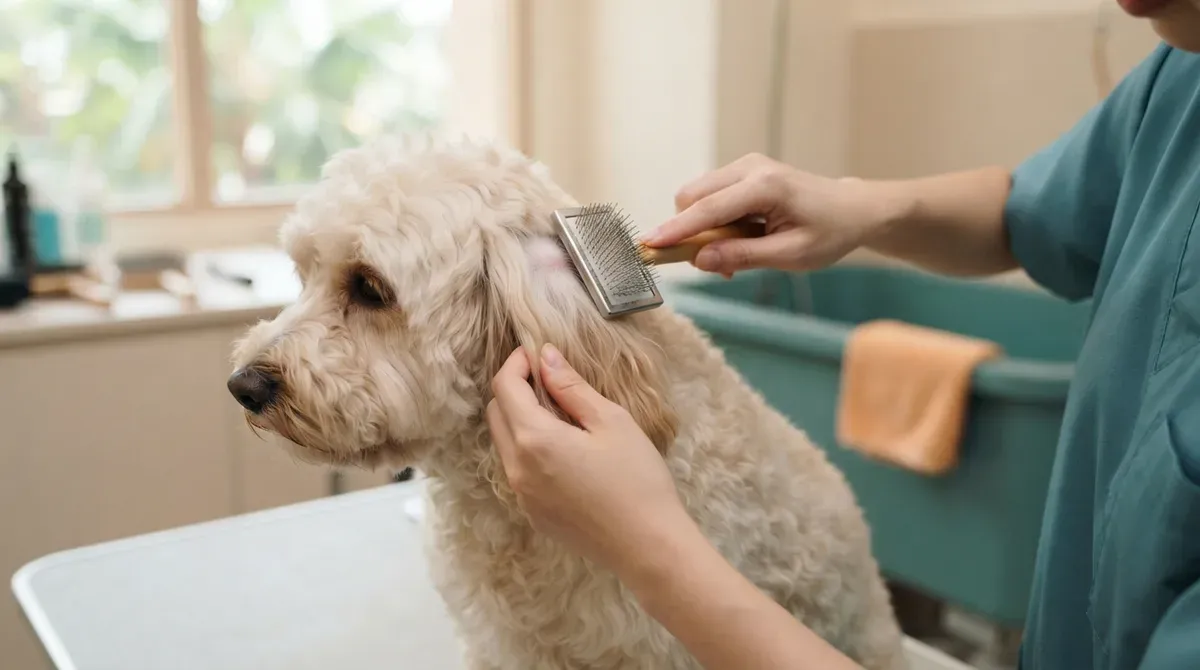
The finish line for any de-matting job is a comb that passes to the skin at every point on the dog. On a small breed with scattered mats that is usually thirty to forty minutes of work, which is $60 to $80 at the most common Singapore rate.
De-matting, de-shedding or a full groom?
These three get confused most in the moment the owner is least able to tell them apart. Dematting versus deshedding is a coat-behaviour question with a one-line answer: if the comb catches and will not pass, that is mat removal, and if fur is coming out everywhere while the comb runs clear, that is a de-shed for a double coat instead.
A coat that is long and untidy but combable does not need rescuing at all. That is what a full groom covers once the coat is clear, and paying a time-based surcharge for it would be the wrong purchase. Where both are needed, dematting before a full groom is the correct order every time, because nothing else can be done properly through a felted coat.
Matted dog hair removal, a de-matting treatment and a detangling service are three names for the same work at three different severities. What professional dematting sells you is time with a rake and a splitter, and the name on the price list matters far less than the unit underneath it.
| What you can feel | The service | Why |
|---|---|---|
| Comb catches, skin lifts with the pull | De-matting | The coat is felted and has to be opened before anything else |
| Hair everywhere, comb passes freely | De-shedding | Dead undercoat is loose in the coat, not tangled |
| Coat over the eyes, comb passes | Full groom | It is length, not condition |
| Matted and double-coated | De-mat first, then reassess | A default clip-off on a double coat is not the right first move |
When de-matting is not the right answer
Some coats should not be de-matted, and saying so costs us a booking we would otherwise pass on. A pelt is the clearest case: clipping is faster, cheaper and considerably kinder than three hours of pulling, and the coat is back to a groomable length in six to eight weeks. the six services compared shows what the same appointment could cover instead.
Broken or infected skin under the mats is a vet appointment before it is a grooming one, and so is any smell coming off the coat. Age is the other one owners argue with. Hours on a table is the wrong trade for a thirteen-year-old, whatever the coat looks like afterwards.
- A pelt, where the coat lifts as one sheet
- Sores, hot spots or broken skin under the matting
- A dog that cannot tolerate long handling, at any age
- An older dog, where hours on a table is the wrong trade
- A coat already booked for a short summer clip anyway
What to ask before you hand your dog over
Four questions at drop-off remove almost every bad outcome described in the community threads on this topic. They take a minute, and a groomer who answers all four cleanly is usually the one you want.
- How do you charge for de-matting, and per what unit?
- What is the most this could come to today?
- Will you call before clipping anything short?
- How will you decide between de-matting and clipping?
- How short would the clip have to be if it comes to that?
Why owners ask each other instead of asking salons
Two Singapore Facebook threads rank on page one of this search, above most of the salon pages, and that is worth saying out loud rather than competing with quietly. a Singapore owners' thread on patient groomers for matted coats is one of them, and it is a better read than any price list, including ours.
Owners typing dematting near me are not shopping for a rate. A patient groomer for a matted dog is what the threads are actually asking for, and a groomer who takes their time cannot be identified from a price list at all, which is exactly why the recommendations outrank the businesses here. Anyone searching dog dematting singapore price finds four different figures and no way to compare them, which is what the table at the top of this page is for.
We are a matching service. We do not groom dogs, we set no prices, and we cannot verify how gentle any individual groomer is on a bad coat. What we can do is pass on what you tell us about the matting so the shortlist suits the dog, and how the shortlist gets put together sets out exactly what happens to your details.
Welfare, licensing and what can be checked
Grooming standards in Singapore sit inside animal welfare guidance rather than a grooming-specific licence. NParks AVS pet licensing covers licensing for pets and for businesses such as pet retail, boarding and import. Grooming-only premises do not appear on the published list of licensable pet businesses, which is an observation about that list rather than a legal conclusion, and it means the checkable things are the ones you check yourself.
If a dog is cut during de-matting, the reasonable expectations are that you are told before you collect, that you are shown the spot, and that the groomer covers the vet visit if one is needed. A nick under a tight mat is a known risk of the work. Not mentioning it is not.
- Ask to see where the dog waits between sessions
- Ask whether anyone stays with dogs during drying
- Ask what happens if the dog says stop halfway through
- Ask to be told about any cut before you collect, not after
What we do with your details
Your details go to the groomers we match you with, and nowhere else. We do not sell contact details on, and we do not pass them to anyone who has not been matched to your enquiry. The Personal Data Protection Commission sets the rules we work to, and the full statement sits on the how it works page.
Read this next
Three guides carry on from here. how often a groom is due here answers the scheduling question this page keeps pointing at, the prevention guide covers line brushing in full, and the early-signs guide is the one to read before a coat ever gets to this stage.
De-matting groomers across Singapore
Island wide groomers cover this, studio and mobile both. One thing worth knowing before you choose: a long job often suits a studio better than a van, because the work can run past an hour and a van is parked outside somebody's block while it does. a groomer who comes to you is still the better answer for a dog that travels badly, and plenty of mobile groomers do this work well.
We have no storefront of our own. Every groomer running a dematting service on our list is an independent business, the groomer sets the price, and you book with them directly. Tell us about your dog's coat in plain words, including how bad the matting has got, and the fastest route from there is to get matched with a groomer who has handled a coat like it before.