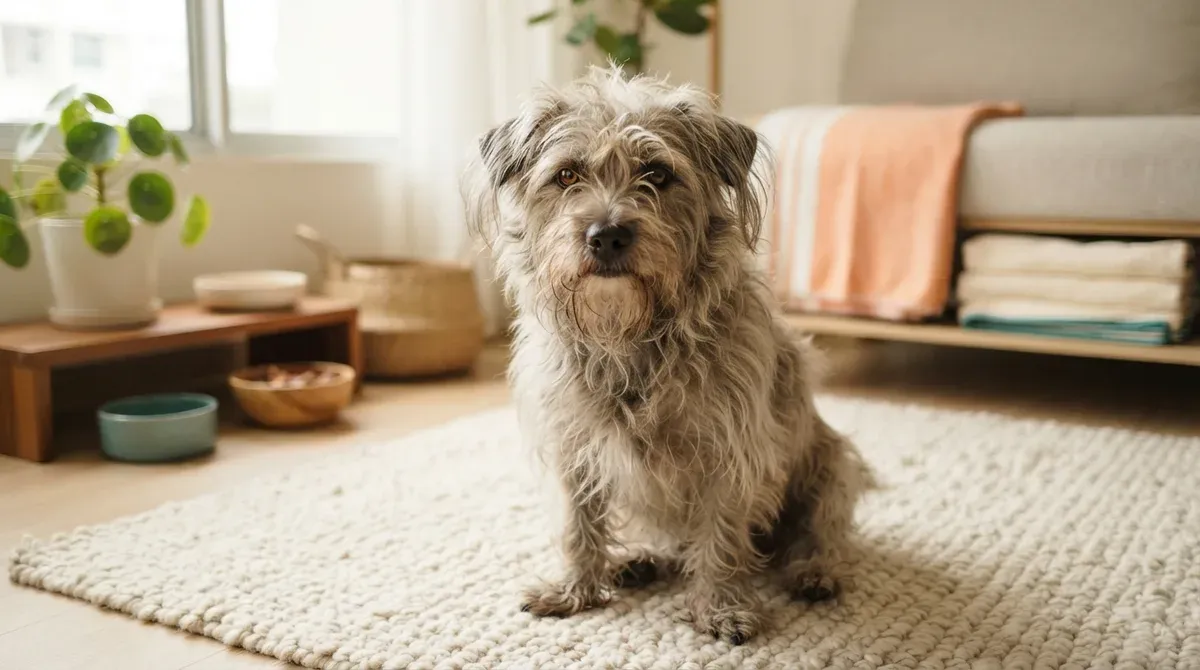
The seven signs at a glance
How do I know if my dog needs grooming is a question with a physical answer rather than a calendar one. These are the signs dog needs a groom that you can check with your hands tonight, and knowing when to take your dog to the groomer is mostly a matter of running through them once a week.
- Mats and tangles, especially behind the ears, under the legs and on the belly
- A doggy smell that returns within days of a bath
- Nails clicking on hard floors, or catching on fabric
- More scratching, licking or chewing than normal
- Dirty, cloudy or smelly ears, or new head-shaking
- Fur over the eyes, or a dog that has started bumping into things
- A dull, greasy or flaky coat that brushing does not fix
1. Mats you can feel but not see
This is the one owners miss most, because a matted dog often looks fine. Mats form against the skin, underneath a surface coat that still brushes smoothly. The only reliable check is with your hands and a comb, not with your eyes.
Run your fingers through the coat down to the skin at the friction points — behind and under the ears, in the armpits, along the collar and harness lines, the back of the hind legs, around the tail base. If you meet a knot you cannot slide a finger under, that is a mat rather than a tangle, and it will not brush out on its own.
Why it matters more than it looks
A tight mat pulls on the skin every time your dog moves, traps moisture and heat against it, and hides whatever is happening underneath. In this climate that trapped moisture is where hot spots and yeast start. Matting is a welfare issue before it is a cosmetic one — our guide to preventing matting covers the brushing technique that stops it forming.
2. The smell that comes back too fast
A clean, healthy dog should not smell strongly a few days after a bath. When the smell returns quickly, it is usually telling you one of three things: the coat is not drying properly to the skin, there is a skin condition producing the odour, or the source is the ears rather than the coat.
In Singapore all three are common, and humidity is the connecting factor — a thick coat that is towel-dried rather than blown out can stay damp at the skin for hours, which is exactly what a bacterial or yeast overgrowth needs. A proper groom with a full blow-dry often solves it outright.
3. Nails you can hear
The rule of thumb is simple: when your dog is standing squarely on a hard floor, the nails should not be touching it. If you can hear clicking as they walk across tiles, the nails are already longer than they should be.
Overgrown nails are not just noisy. They change the angle the toes sit at, which shifts weight through the foot and up into the leg, and over time that affects how a dog stands and moves. Long nails also catch and tear, which is painful and bleeds a lot.
Why waiting makes it harder to fix
Inside each nail is the quick — the blood supply and nerve. As a nail grows long, the quick grows out with it. That means a dog with badly overgrown nails cannot simply be cut back to a normal length in one appointment; it takes a series of small trims a couple of weeks apart to let the quick recede. Nails are worth keeping on their own three-to-four week schedule regardless of when the coat is due.
4. Scratching, licking and chewing
An increase in any of these is a signal, and the location tells you a lot. Generalised scratching often points to skin that is dry, dirty or reacting to something. Concentrated licking or chewing at one spot — a paw, a flank, the base of the tail — is more likely to be irritation, a mat pulling, or something caught in the coat.
Grooming resolves a good proportion of this: a wash removes the accumulated dust, pollen and sweat that build up against the skin in this climate, and brushing out a mat removes the tension causing the licking. But persistent itching that does not improve after a groom is a veterinary question, not a grooming one.
A coat that has gone flat is the version of this sign owners miss, because it looks like nothing. The ASPCA's grooming checks describe the same pattern: dull, lifeless coat plus increased scratching usually means the skin underneath is not getting air, which in this climate means something is sitting against it.
5. Ears
Healthy ears are pale, more or less odourless and clean-looking inside. What you are watching for is dark waxy discharge, redness, a distinct smell, head-shaking, or a dog that pulls away when you touch one ear.
Drop-eared and heavily coated breeds are at greater risk here because the ear canal stays warm and poorly ventilated, and hair growing inside the canal traps moisture. Regular ear cleaning is part of a normal full groom, and for some breeds so is trimming or plucking the hair around the canal opening.
6. Fur over the eyes
On Shih Tzus, Maltese, Lhasas and many doodle crosses, the face furnishings keep growing. Left too long they hang into the eye, which is uncomfortable, causes watering, and in some dogs leads to corneal irritation from hair rubbing the surface of the eye directly.
The behavioural clue is often clearer than the visual one: a dog that has started hesitating on stairs, misjudging jumps, or bumping into furniture it normally navigates fine may simply not be able to see properly. A face trim or a tied top-knot fixes it in ten minutes.
7. Coat that has stopped looking right
A coat in good condition has some shine to it and feels clean rather than sticky. When it goes dull, greasy or flaky and brushing does not improve it, something is off — either build-up that needs a proper wash, or a skin issue underneath.
A sudden change in shedding volume or in coat texture is a separate signal worth noticing. Dogs here shed steadily year-round rather than in two clean seasonal moults, so a genuine step-change in how much fur you are finding is unusual and can point to stress, diet or a medical cause rather than to grooming.
Signs that need a vet, not a groomer
Most groomers will decline to work on a dog presenting any of these, and they are right to. Get them looked at first, then book a grooming appointment. Routine health checks are the AVS's own framing for the difference: some of what you find while combing is a coat problem and some of it is a health one.
| What you are seeing | Who to see |
|---|---|
| Mats, overgrown coat, long nails, dirty ears | Groomer |
| Smell that returns after a bath, general dullness | Groomer first, vet if it persists |
| Red, weeping or bald patches on the skin | Vet |
| Head-shaking, ear odour or discharge | Vet |
| Lumps, scabs or wounds under the coat | Vet |
| Sudden heavy shedding or a change in coat texture | Vet |
| Pain or flinching when touched in a specific spot | Vet |
Why these appear faster in Singapore
Year-round heat and humidity mean coats hold moisture for longer, which is the condition mats form in and the condition skin problems prefer. Without a real cold season, many dogs here shed continuously rather than in two seasonal blowouts, so there is always loose hair sitting in the coat waiting to felt.
The practical consequence is that a grooming interval that works perfectly well overseas is often two weeks too long here. If you are seeing these signs on a schedule you thought was reasonable, the schedule is the thing to change — our frequency guide sets out realistic intervals by coat type.
Matching the service to the sign
If you are seeing two or more signs, book a groomer, and book the right thing. Paying for a full groom when the problem is nails, or a bath when the problem is a matted coat, wastes an appointment.
What to tell the groomer matters as much as which service you pick. Say the coat is matted if it is, because a de-matting charge is time-based and how de-matting is charged is the one thing that turns a normal quote into a surprising one. The cost of a groom Singapore side runs $70 to $350 for a full groom by size, and the price guide carries the bands.
Groomer versus vet is the other call to get right, and the three signs in the next section are the ones where a grooming appointment is a delay rather than a fix.
If you would rather not ring round, get matched with a groomer instead: one description, sent to groomers who cover your block. It is a free quote dog grooming enquiry with nothing to pay, and it is the fastest way to find a groomer in Singapore who already handles your dog's coat type.
| The main problem | What to book |
|---|---|
| Knots and mats you cannot comb through | De-matting |
| Overgrown coat, fur in the eyes, general untidiness | Full grooming |
| Clean dog, coat fine, nails long | Nail trimming |
| Fur everywhere at home, double-coated dog | De-shedding |
| Smell and grubbiness, coat still in good shape | Bath & tidy |
| Puppy that has never been groomed | Puppy grooming |
What Singapore actually requires of you
Grooming is not optional here in the way owners sometimes assume. The Code of Animal Welfare for pet owners treats coat and nail care as part of the basic standard of care an owner is expected to meet, not as grooming for appearance. The AVS Code of Animal Welfare is the document to read if you want the actual wording rather than a summary.
That is the honest frame for this whole list. A matted coat, nails growing into a pad or ears left until they smell are welfare matters before they are cosmetic ones, and none of them are hard to prevent once you know what you are feeling for.
It is also why choosing well matters at the other end. SPCA Singapore's guidance on choosing a groomer covers what to look for before you leave a dog anywhere.
Sign six: you cannot remember the last one
How long can a dog go without being groomed is the question underneath every other sign on this page, and the practical answer for a coat that keeps growing is professional grooming every 6 to 8 weeks. If you cannot remember the last appointment, you are past it.
AVS's own guidance on coat care puts continuously growing coats in the same six to eight week range, which is worth knowing because most breed guides online are written for temperate climates and stretch it further.
The Singapore humidity dog coat problem is why the local interval sits at the shorter end. A coat that never fully dries mats faster than the same coat anywhere cooler, and the calendar is a poorer guide here than the comb is.
Checking properly takes two minutes
Make it a weekly habit and you will never be surprised. Three checks cover almost everything. The hand test: run a flat hand against the lie of the coat and feel for lumps rather than looking for them. The comb to the skin test at each friction point, especially mats at the ear roots, which is where they start. And the stand test for nails: stand the dog on a hard floor and look at whether the nails touch it.
- Comb behind and under both ears
- Comb the armpits and the collar or harness line
- Comb the back legs and around the tail base
- Look inside both ears for wax, redness or smell
- Check nails against the floor with the dog standing square
- Part the coat on the back, belly and flanks and look at the skin