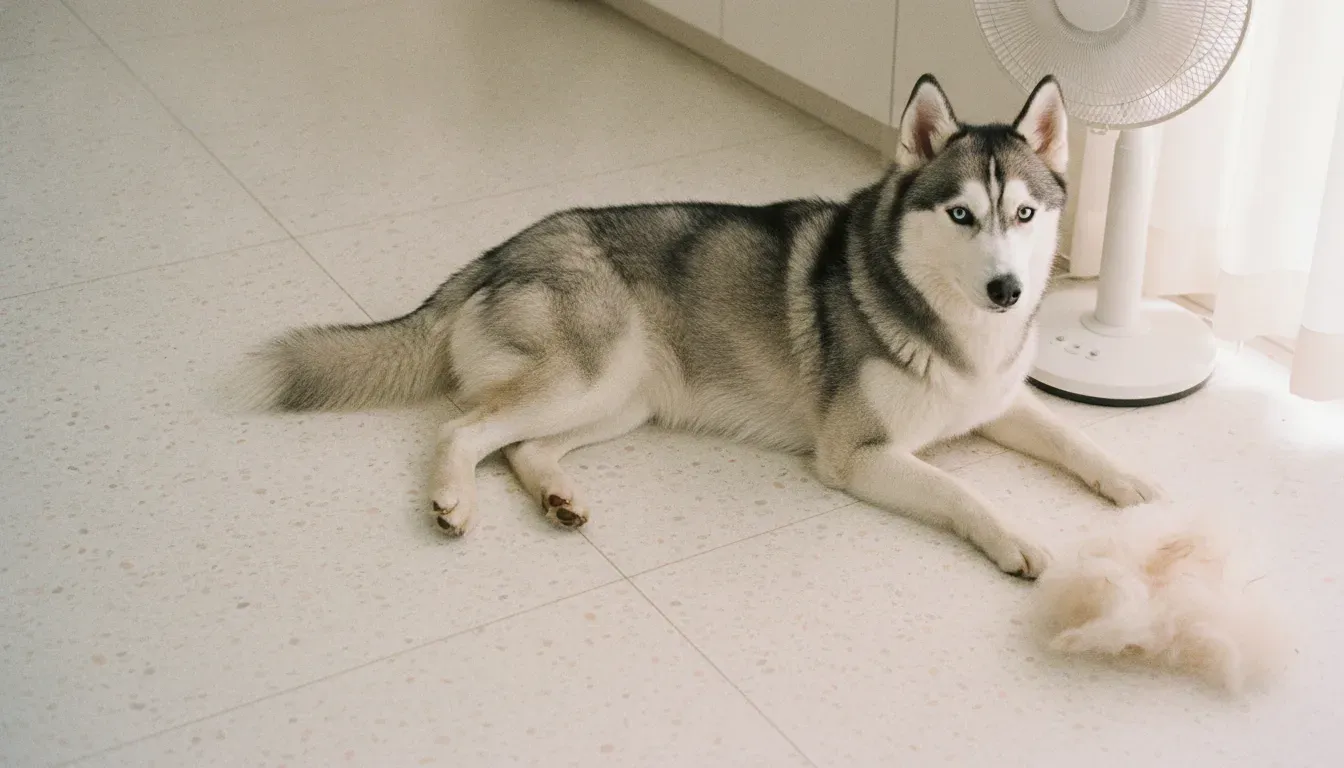
How a double coat works
A double-coated dog has two distinct layers. The undercoat is soft, dense and short — it insulates by trapping a layer of air against the skin. The topcoat, or guard coat, is coarser and longer; it repels water and dirt and, critically in this climate, blocks sun and reflects heat away from the skin.
The insulating layer works in both directions. The same trapped air that keeps a Husky warm in snow also slows hot outside air from reaching the skin. That is the part that surprises people: the coat is not simply a jumper the dog cannot take off, it is closer to the insulation in a wall.
Which breeds this covers
Double coats are more common in Singapore than people assume — the list is not just the obvious northern breeds.
| Breed | Coat | Shedding here |
|---|---|---|
| Pomeranian | Dense, long guard coat over thick undercoat | Heavy, near-continuous |
| Corgi (Pembroke / Cardigan) | Medium, extremely dense undercoat | Very heavy |
| Shiba Inu | Short, harsh guard coat, plush undercoat | Heavy in bursts |
| Siberian Husky | Thick, the most insulating on this list | Very heavy, seasonal blowouts |
| Golden Retriever | Long, feathered, water-repellent | Heavy and continuous |
| German Shepherd | Medium to long, dense | Very heavy |
| Japanese Spitz | Long, stand-off white coat | Heavy |
Why shaving is the wrong answer
Clipping a double coat to a uniform short length removes the guard coat along with the undercoat. Three things follow. The skin loses its sun barrier, which matters on a sunny walk. The coat loses the air layer that slows heat transfer in both directions. And the regrowth is unpredictable: the undercoat regrows faster than the guard hairs, so the coat can come back patchy, softer, and denser in texture than it was — a change that is sometimes permanent in older dogs.
There is also a comfort argument that gets overlooked. A clipped double coat often regrows in a way that mats more readily than the original coat did, which means the dog that was shaved for an easier life ends up needing more grooming, not less.
When clipping a double coat is justified
There are genuine exceptions, and a good groomer will tell you when you are in one. A coat that is so severely matted or pelted that brushing it out would cause real distress should come off — welfare beats coat structure every time. Medical reasons, surgery sites, and some senior dogs who cannot tolerate long grooming sessions are also legitimate cases. What is not a good reason is a general assumption that shorter equals cooler.
What de-shedding actually involves
De-shedding is not a haircut. It is a process for removing the dead undercoat while leaving the guard coat intact, and done properly it takes considerably longer than a bath.
- A deep bath with a shampoo that helps release the undercoat
- A conditioning or de-shedding treatment left to work
- A thorough rinse — residue is what makes coat sticky
- A high-velocity blow-out that physically forces loose undercoat out of the coat
- Undercoat raking and brushing to clear what the dryer loosened
- Nails, ears and paw pads as part of the appointment
How often, and what it costs
Every four to six weeks suits most double-coated dogs in Singapore, and the interval matters more here than in a temperate climate because there is no clean seasonal moult to work around — these dogs shed steadily all year, so dead undercoat accumulates continuously rather than in two predictable bursts.
On the ranges in our price guide, de-shedding is usually priced as an add-on from around $20 for a small dog, $35 for a medium and $60 for a large one, on top of the bath or groom. A Husky or a German Shepherd sits at the top of that because the volume of coat is simply larger and the blow-out takes longer.
Brushing a double coat at home
The tools are different from those for a curly or silky coat. A slicker brush works on the surface; what you actually need is something that reaches the undercoat. An undercoat rake pulls dead hair out of the dense layer, and a wide-toothed comb checks your work.
Technique matters less here than persistence. Work in sections, going with the lie of the coat rather than against it, and pay particular attention to the hips, the ruff around the neck, and behind the ears — where the undercoat is densest and packs hardest.
- Undercoat rake two to three times a week, daily during a heavy shed
- Slicker brush afterwards to lift what the rake loosened
- Concentrate on hips, ruff, chest and behind the ears
- Do it outdoors or somewhere you do not mind a large volume of fur
- Never rake hard on the same spot — it scratches the skin
- Bathe less often than you would a single-coated dog; over-bathing dries the skin
Deshedding blades: use with care
Furminator-style tools with a fine cutting blade are popular and genuinely effective, but they cut the hairs they pull through rather than only removing dead ones. Used heavily or weekly, they thin and damage the guard coat over time — which produces exactly the coat-texture change owners were trying to avoid by not shaving.
A reasonable approach is to use one sparingly, on a clean and fully dry coat, with light pressure, and to rely on a rake and a dryer for the routine work. If you are using a blade tool weekly and hard, that is worth reconsidering.
Keeping a double-coated dog comfortable here
The coat is one part of heat management and not the largest. Timing, water and surfaces matter more day to day, particularly for the northern breeds who genuinely do struggle in this climate.
- Walk early morning and after dark; avoid midday entirely
- Check pavement temperature with the back of your hand before walking
- Carry water on every walk, however short
- Keep a well-ventilated spot at home; a cooling mat helps more than a fan
- Watch for heavy panting, drooling, unsteadiness or bright red gums — signs of heat stress
- Keep the coat free of dead undercoat so air can move through it
Common mistakes
- Shaving to keep the dog cool — the opposite of what it achieves
- Using only a slicker brush and never reaching the undercoat
- Bathing frequently, which dries the skin without removing undercoat
- Letting the coat go eight to ten weeks between de-sheds
- Using a deshedding blade weekly and with pressure
- Assuming a Corgi's shorter coat means less undercoat — it has more than most
When to see a vet instead
Some coat problems on double-coated breeds are not grooming problems. Symmetrical hair loss, bald patches, skin that is thickened or darkened, a coat that fails to regrow after a clip, or a sudden step-change in shedding volume are all worth a veterinary opinion — hormonal conditions and skin disease present exactly this way, and no amount of raking will fix them.
Similarly, a dog that has become intolerant of brushing in a specific area may have something painful underneath rather than a behavioural objection. Check for hot spots under the coat, which in this humidity develop quickly beneath a packed undercoat and are easy to miss until they are large.