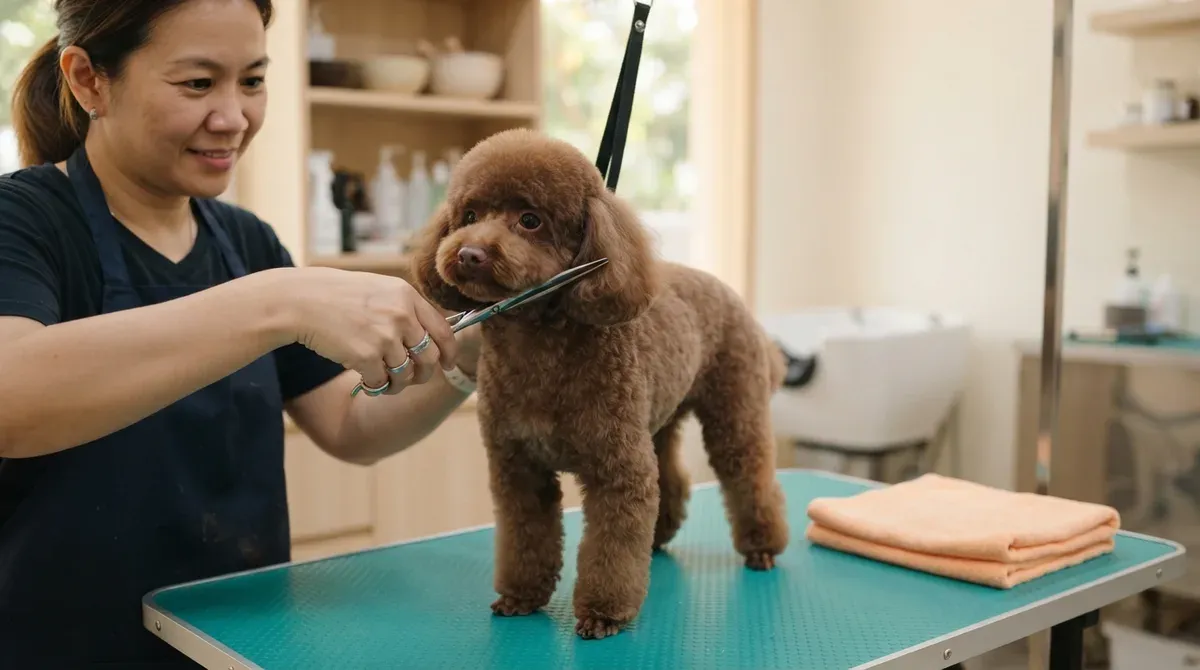
Why curly coats mat faster than anything else
Every dog sheds. What makes a curly coat different is where the shed hair goes. On a short-coated dog it falls out onto your floor. On a Poodle or a doodle the curl catches it, so it stays in the coat, wraps around the hairs still growing, and compresses into felt against the skin. The low-shedding quality owners choose these dogs for is the same quality that makes the coat high-maintenance.
Singapore adds two more factors. Humidity keeps the coat slightly damp for far longer after walks and baths, and damp curly hair tightens as it dries. And year-round warmth means the shedding is continuous rather than seasonal, so there is always loose hair sitting in the curls.
The coat types you might actually have
"Doodle" is not a coat description. Knowing which of these you have tells you how much work you are in for and what cut will hold.
| Coat | Feel | Sheds | Maintenance |
|---|---|---|---|
| Poodle wool | Tight, dense, springy curl | Very little | High — brush daily, mats close to the skin |
| Doodle fleece | Soft wavy curl, silky | Little | High — the most matting-prone of the three |
| Doodle wavy / hair | Loose wave, coarser | Moderately | Medium — mats mostly at friction points |
| Straight (doodle throwback) | Flat, retriever-like | Yes, noticeably | Low — brushing rather than dematting |
The adolescent coat change
Somewhere between about eight and fourteen months, the soft puppy coat is replaced by the adult coat. During that window the old coat sheds into the new one and mats at a rate that has very little to do with how conscientiously you are brushing. Owners almost universally assume they have started doing something wrong. They usually have not.
This is the single most common reason a doodle arrives at a groomer pelted at ten months old having been brushed regularly. The coat genuinely outruns normal maintenance for a few months.
How to get through it
- Increase brushing to daily, and line-brush rather than surface-brush
- Go shorter than you want for the duration — length you cannot maintain is not a style
- Shorten the professional interval to every four weeks rather than six
- Expect it to settle; the adult coat is easier than the transition
- Do not fight to keep a long coat through it — that is how dogs learn grooming hurts
Brushing that actually works
Brushing the top of a curly coat achieves nothing useful. The mats form underneath, and a slicker brush has flexible pins that bend around a mat and glide over it — which is exactly why a coat can feel thoroughly brushed and be solidly matted at the skin.
The technique that works is line brushing: push the coat upward with your free hand to expose a parting down to the skin, brush only the narrow band below the parting, then release another centimetre and repeat, working steadily up the body. Then test the section with a metal comb. The comb is the honest tool — it has rigid teeth that stop dead at anything solid. Our matting-prevention guide covers the full method.
- Line-brush most days — five minutes daily beats forty on Sunday
- Always finish with a metal comb; if it snags, you are not done
- Mist lightly with water or a detangler first — dry curly coat breaks
- Prioritise behind the ears, armpits, harness lines, back legs and tail base
- Brush after every swim and after any walk that got the coat wet
The cuts that hold in this climate
The best cut for your dog is the one you can maintain, not the one in the photograph. A long teddy-bear coat needs genuine daily work; if that is not going to happen, choosing it anyway means paying for de-matting later and getting a short cut in the end regardless.
| Cut | What it is | Upkeep |
|---|---|---|
| Puppy cut | Even short-to-medium length all over, rounded face | Moderate — the practical default here |
| Teddy bear | Longer, rounded head and softer lines | High — daily brushing, not optional |
| Summer / kennel clip | Short all over, often 6–12mm | Low — the honest choice for busy owners |
| Lamb trim | Short body, longer legs | Moderate to high — the legs are the work |
| Full scissored / show-style | Sculpted, considerable length | Very high — for owners who enjoy the maintenance |
Face, feet and ears
Curly-coated breeds need specific attention in three places that the body clip does not cover. Face furnishings keep growing and end up in the eyes, causing watering and, in some dogs, irritation from hair rubbing the surface of the eye. Feet grow hair between the pads, which mats, traps grit and makes tiled floors slippery. And the ears are the part most often neglected.
Poodles and many doodles grow hair inside the ear canal. Combined with a drop ear that keeps the canal warm and poorly ventilated, that is a setup for moisture retention — and in Singapore's humidity, ear infections in these breeds are common. Whether hair should be plucked from the canal or trimmed is a question with genuine professional disagreement; what is not in dispute is that the ears need checking weekly and keeping dry.
What a groom costs, and why doodles cost more
On the ranges in our price guide, a small Poodle full groom typically sits around $70–130, a medium doodle around $110–200, and a large doodle $150–350. Doodles reliably sit at the top of their size band, and it is worth understanding why rather than assuming you are being overcharged.
A full groom on a curly coat is a long job: the coat has to be brushed out completely before bathing, blown fully dry to the skin (a partly dry curly coat cannot be scissored evenly), brushed again, and then scissored rather than simply clipped. Matting adds time on top of all of that, and time is what is being priced.
- Book on schedule — the interval is what keeps you at the lower end
- Brush at home; de-matting fees are the main cause of surprise quotes
- Choose a length you can genuinely maintain
- Ask for the price band and what would push it higher, before the appointment
- Do not stretch to eight weeks on a fleece coat to save money — it rarely does
Common mistakes
- Brushing only the surface and believing the coat is done
- Bathing a matted coat — water tightens mats significantly
- Letting a curly coat air-dry flat against the skin
- Choosing a long cut to match a photo, then not brushing daily
- Waiting until the coat is a problem before booking
- Cutting mats out at home with straight scissors
- Assuming low-shedding means low-maintenance
When it is skin, not coat
Curly-coated breeds are prone to a few things worth separating from grooming. Recurring ear infections, itchy paws, or coat that mats persistently in the same place despite brushing can point to allergy or yeast rather than to technique. A groom will not fix any of those.
The signals to take to a vet rather than a groomer are redness or weeping skin, a sweet or musty smell, head shaking, or a dog that flinches when touched in a specific spot. Get those looked at first; the groom can follow.